
ROI Case File No.552: '"Busy" Alone Couldn't Tell Us Where the Weight Was'

"Busy" Alone Couldn't Tell Us Where the Weight Was
Chapter 1: We Know We're Busy, But What Is the Weight?
"The back office is just plain busy. We want to make it efficient with AI, but we can't figure out where to start."
Yosuke Kamaya, CEO of TechGastro, described his situation as he spoke. His company runs more than twenty restaurants across Tokyo. "HR, general affairs, creating promotional materials, social media operations—we run all of it with three back-office staff. The load is too high. We use a little generative AI, but full adoption is still ahead of us."
"Which task is the heaviest?" Claude asked.
"That's the thing—I can't say clearly," Kamaya answered. "All of it is busy, is all I can say. It feels like data processing and aggregation takes time, and it also feels like we're chased by social media operations. There's just a vague sense of 'this is rough.'"
"This sense of being busy—which scene, which task is it about?" I asked, to confirm.
"...Now that you ask, I'm stuck for an answer," Kamaya said. "I'd lumped everything under 'busy.' I've never looked at where the weight is, broken apart."
"As long as you lump busyness together, you can't narrow your move," I replied. "Let's break it down with SBI."
Chapter 2: SBI Asks—Observe by Situation, Behavior, and Impact
"This case calls for SBI."
Claude wrote "Situation, Behavior, Impact" on the whiteboard.
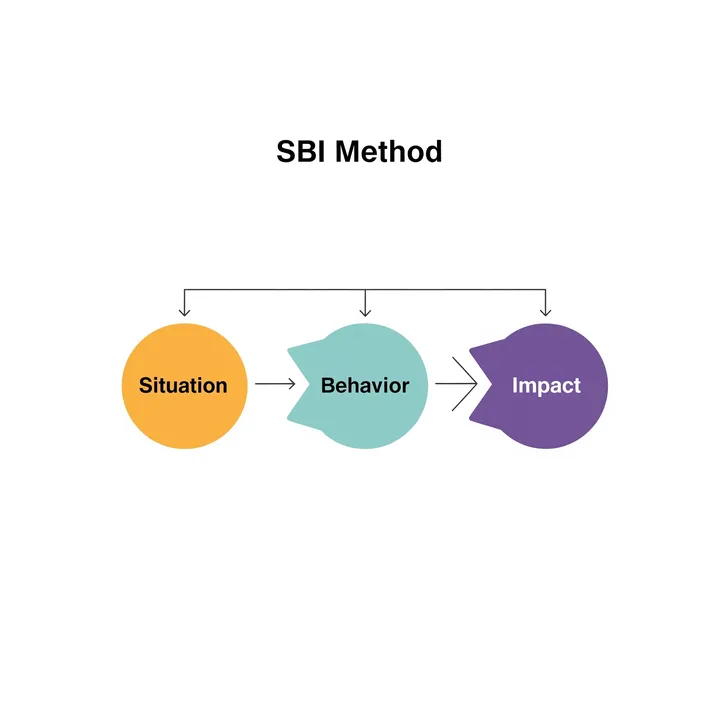
"SBI—Situation, Behavior, Impact—is a framework for observing a vague phenomenon concretely along three points: when and where, what was done, and what result came out," I explained. "The key is turning an impression into an observation. 'Busy' is an impression, and it isn't a move. In which situation, in which behavior, how much impact is appearing? Only after you break it into specifics does the single point to automate come into view."
"Let's measure the current cost first," Gemini said, opening ROI Polygraph, and entered the data Kamaya had provided.
"The monthly cost is in," Gemini read out. "Overload hours from running HR, general affairs, promotion, and social media with a small team average 200 hours a month; at ¥3,600 an hour, that's ¥720,000 a month. Manual hours for data processing and aggregation average ¥420,000 a month. Lost opportunity from stalled use due to a shortage of AI know-how and internal literacy averages ¥360,000 a month. The expected value of business-continuity risk from work being person-dependent on three people averages ¥380,000 a month. Data fragmentation and double entry from a lack of a store-management SaaS average ¥300,000 a month. The total is ¥2,180,000 a month—roughly ¥26.16 million a year."
Kamaya stared at the figures. "This is the first time I've seen the sense of being busy as a monetary figure. Measured separately, where the weight is floats to the surface."
"Then let's design it with SBI," I continued.
[Situation—Pin down when and where it happens]
"First, we pin down the situation in which the busyness occurs," Claude said. "Is it during month-end aggregation, during the prep for a social media post, or during recruiting? We slice 'busy' by the scene where it arises. Only after limiting the situation does observation begin."
[Behavior—Write down concretely what is being done]
"Next, we write out the behavior actually being done in that situation," Gemini continued. "'Copying and pasting data and re-aggregating it by hand'—we describe it in actions, not impressions. Once the behavior is concrete, we can judge whether it can be handed to AI."
[Impact—Measure the result the behavior produces]
"After behavior, we measure the impact it produces," I continued. "How many hours does that task take, and how much rework does it create? Turn the impact into numbers and the heavy behaviors get ranked. You can act from the heaviest first."
[The move—Hand the high-impact behaviors to AI]
"Finally, we hand the high-impact behaviors to AI," Claude continued. "Automating data processing and aggregation, generation support for promotional materials and social media. Rather than changing everything at once, we automate from the single heavy point identified by observation. At the same time, with AI training for employees, we make sure the floor can run it."
[Estimating the payback]
"Let's run the numbers with ROI Proposal Generator," Gemini proposed.
- Initial cost: Back-office automation base, automation of data processing and aggregation, promotion/social-media generation support, AI training, and store-data integration design—¥5,500,000 total
- Monthly cost: Tool usage fees and ongoing operations combined—¥220,000 a month
- Monthly savings: Automating the small-team overload = ¥540,000 a month (assuming a 70% reduction); automating data processing and aggregation = ¥340,000 a month; expanded use from improved literacy = ¥340,000 a month; double entry eliminated by store-data integration = ¥300,000 a month; ¥1,520,000 a month total
- Net monthly savings: ¥1,520,000 − ¥220,000 = ¥1,300,000 a month
- Payback period: ¥5,500,000 ÷ ¥1,300,000 = about 4.2 months
"Payback in just over four months," Gemini summarized. "What works is automating from the heavy behavior identified by observation rather than making everything efficient at once. As long as it stays 'busy,' wherever you invest, it gets diluted. Because you separate by Situation, Behavior, and Impact and enter from the heaviest first, the investment doesn't whiff."
Kamaya said, checking the figures, "I'd been trying to crush busyness all at once. Observed separately, where to start gets decided."
"SBI is the tool that turns an impression into an observation and narrows the move," I replied.
Chapter 3: A Rollout Plan That Automates from the Heavy Behavior
"Let me lay out the approach," I said, standing at the whiteboard.
"Month 1—decompose the back-office work into situations and observe; pin down the scenes where busyness arises. Month 2—write out the behaviors, measure the impact, and rank the heavy behaviors. Months 3–4—build the automation of data processing and aggregation and the promotion/social-media generation support. Month 5—AI training for employees and store-data integration. Month 6—pilot operation and effect verification. Month 7 onward—expanding the automation scope and rolling it out laterally to stores of the same scale."
"Will the work three people are running really get lighter?" Kamaya asked, to confirm.
"It will get lighter," Claude replied. "What's heavy isn't everything—it's a specific behavior. Observed with SBI, you see that the load concentrates in a small number of high-impact tasks. Hand those to AI and the three people's hands free up. Because you've found the single heavy point through observation, the effect of automation shows on the surface."
Kamaya said, taking notes, "Break busyness apart and observe it before automating. I can see the order now."
Chapter 4: The Day the True Identity of Busyness Came into View
Nine months later, a report arrived from Kamaya.
Data processing and aggregation had its manual work almost vanish after automation. "The work of copying, pasting, and re-aggregating now lines up automatically. The month-end peak smoothed out," Kamaya had written.
Promotional materials and social media operations grew lighter, too. Generation support handled the drafts and rough plans, and people could move to checking and adjusting. "Promotions we'd built from zero could now start from a first draft. The feeling of being chased by posts went down," the report said.
The biggest change appeared in how busyness was grasped. From vaguely saying "this is rough," it changed to a state where they could say where the weight was. "We stopped saying 'everything is busy.' We could now say in numbers which scene's, which task's weight it was. The move stopped wavering," Kamaya had written.
The risk of person-dependence dropped, too. Work that had been closed inside three people began to be shared through mechanisms and cases. "The anxiety of 'it stops if a specific person isn't here' eased," the report said.
As a secondary effect, the basis for judgment changed. The idea of viewing things separated by Situation, Behavior, and Impact took root on the floor. "We stopped ending meetings on 'busy.' We came to talk in terms of which behavior is heavy," Kamaya had written.
At the end of his report, he wrote: "I thought the back-office troubles in food service were about a labor shortage. But the real problem was lumping busyness together and never separating where the weight was. The moment we separated it by Situation, Behavior, and Impact with SBI, the single point to automate came into view. Before making a move, observing came first."
The day a company that spoke of weight with only the word "busy" became a company that could say where the weight was, AI operational efficiency had changed from dissolving vague busyness into a design that observes by Situation, Behavior, and Impact before automating, the report noted.
"Operational-efficiency requests usually come in the form of 'we're just busy.' But busy is an impression, not a move. What SBI asks is Situation, Behavior, and Impact. When and where, what was done, and what result came out. Only after breaking it into specifics does the single heavy point come into view. The day a company that spoke of weight with only 'busy' could say where the weight was, what changed wasn't the AI tool but the very perspective that turns an impression into an observation and narrows the move."
Related Files
Tools Used
- ROI Polygraph — Visualizing small-team overload hours, data-processing hours, and person-dependence risk
- ROI Proposal Generator — Payback simulation for AI operational efficiency starting from observation by Situation, Behavior, and Impact


