
ROI Case File No.554: 'The Tailwind Was Blowing, Yet We Kept Producing on Gut Feel'

The Tailwind Was Blowing, Yet We Kept Producing on Gut Feel
Chapter 1: Producing on Gut Feel, Piling Up Disposal
"We want to build a demand-forecasting AI. Inventory on the verge of disposal is piling up at the distribution center."
Kenji Kuramoto, head of corporate planning at GlobaTech, described his situation as he spoke. His company has about 400 client firms nationwide. "Production planning relies on each factory's manufacturing manager's experience and gut feel. So overproduction won't stop. Food loss has become a serious problem."
"Is demand hard to read?" Claude asked.
"It's hard to read," Kuramoto answered. "Demand swings widely with weather and season. Produce on a guess and you miss. The miss becomes disposal. If a sharp veteran leaves, we'll miss even more."
"Is there an external environment pushing your company toward the decision to forecast demand with AI?" I asked, to confirm.
"I feel like there is," Kuramoto answered. "Food-loss reduction is a trend of the times, and AI technology is advancing. But I can't properly read whether that's a tailwind for the investment. I just somehow feel 'we should do it now,' and the grounds are weak."
"If a tailwind is blowing, we have to read it from four directions," I replied. "Let's break it down with PEST."
Chapter 2: PEST Asks—The Four Directions of Political, Economic, Social, Technological
"This case calls for PEST."
Claude wrote "Political, Economic, Social, Technological" on the whiteboard.
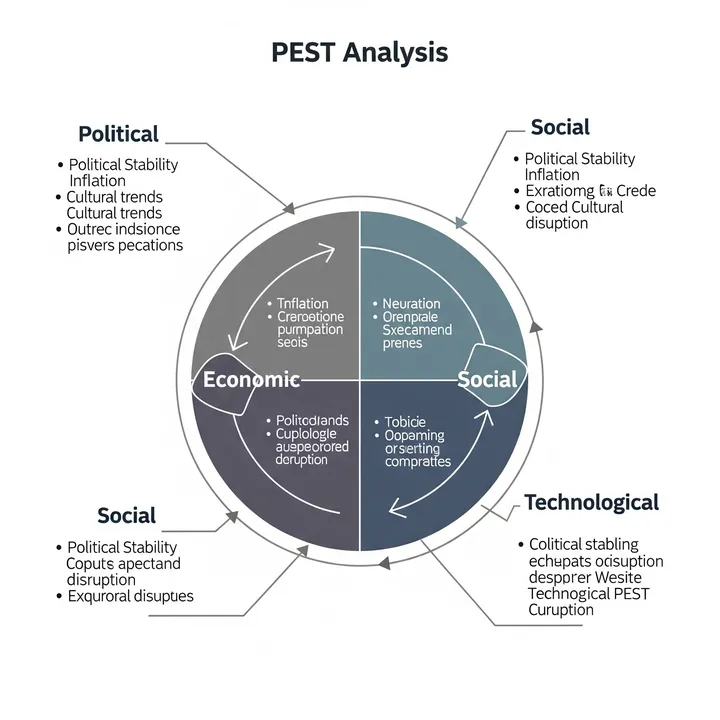
"PEST—Political, Economic, Social, Technological—is a framework for reading the external environment surrounding your company along four directions," I explained. "The key is grasping the tailwind by structure, not gut feel. Read the four directions—policy, economy, consumer awareness, technology—and you can say with grounds whether to invest now. It's the tool that turns 'somehow now' into 'now, because these four have aligned.'"
"Let's measure the current cost first," Gemini said, opening ROI Polygraph, and entered the data Kuramoto had provided.
"The monthly cost is in," Gemini read out. "Hours for adjusting and revising production plans by experience and gut feel average 170 hours a month; at ¥4,100 an hour, that's ¥697,000 a month. Disposal and inventory write-off losses at the distribution center from overproduction average ¥620,000 a month. Lost sales opportunity from stockouts due to delayed response to demand swings averages ¥400,000 a month. The expected value of business-continuity risk from person-dependence on manufacturing managers averages ¥350,000 a month. Lost analysis opportunity from un-utilized demand data across 400 firms averages ¥320,000 a month. The total is ¥2,387,000 a month—roughly ¥28.64 million a year."
Kuramoto stared at the figures. "I thought it was just the cost of disposal. Once you include relying on gut feel itself and not being able to use the data, I never imagined it would be this much."
"Then let's design it with PEST," I continued.
[Political—Read the policy tailwind]
"First, we read the political direction," Claude said. "Through the government's food-waste reduction policy, food-loss reduction is emphasized as corporate social responsibility. Adopting AI is both regulatory compliance and a lift to corporate image. Policy is the tailwind for the investment."
[Economic—See the structure of cost and profit]
"Next, we see the economic direction," Gemini continued. "The outlook for consumption is uncertain, and purchasing behavior is hard to read. Precisely because of that, accurate demand forecasting separates lower inventory cost from maximized profit. Economic uncertainty pushes up the value of forecast accuracy."
[Social—Capture the shift in consumer awareness]
"After economy, we capture the social direction," I continued. "Consumers' interest in food loss is rising, and sustainable corporate activity is demanded. An effort to reduce food loss becomes material for earning consumer trust. Social awareness is a tailwind."
[Technological—Confirm the maturity of usable technology]
"Finally, we confirm the technological direction," Claude continued. "With AI's advance, the accuracy of demand forecasting has risen dramatically. With data from 400 firms, you can use it for training. Because the technology has matured now, you can replace gut feel with forecasting."
[Estimating the payback]
"Let's run the numbers with ROI Proposal Generator," Gemini proposed.
- Initial cost: Demand-forecasting AI build, a 400-firm data integration base, inventory-optimization integration, and on-site verification—¥5,600,000 total
- Monthly cost: System operations and ongoing model updates combined—¥260,000 a month
- Monthly savings: Overproduction and disposal reduced = ¥620,000 a month; planning hours from gut-feel dependence reduced = ¥460,000 a month; stockout opportunity recovered = ¥320,000 a month; accuracy improved through data utilization = ¥260,000 a month; ¥1,660,000 a month total
- Net monthly savings: ¥1,660,000 − ¥260,000 = ¥1,400,000 a month
- Payback period: ¥5,600,000 ÷ ¥1,400,000 = about 4.0 months
"Payback in four months," Gemini summarized. "What works is not judging demand forecasting by technology alone but investing after reading the tailwind across the four directions. Because policy, economy, society, and technology are aligned, the grounds for entering now stand. Rather than deciding 'now' on gut feel, you justify it by structure, so the investment doesn't whiff."
Kuramoto said, checking the figures, "I'd just somehow felt we should do it now. Read across four directions, you can say with grounds that the tailwind is aligned."
"PEST is the tool that reads the tailwind by structure, not gut feel," I replied.
Chapter 3: A Rollout Plan That Reads the Four Directions Before Moving
"Let me lay out the approach," I said, standing at the whiteboard.
"Month 1—PEST analysis of the external environment and fixing the investment grounds. Month 2—inventory the demand data of 400 firms and design the integration. Months 3–4—build the demand-forecasting AI and the inventory-optimization integration. Month 5—on-site verification at some factories and accuracy measurement. Month 6—company-wide deployment and settling in operations. Month 7 onward—continuous improvement of the forecasting model and measuring the food-loss reduction effect."
"If the forecast misses, won't disposal come out again in the end?" Kuramoto asked, to confirm.
"Accuracy rises with data," Claude replied. "Gut feel misses because the judgment material is individual memory. We train the model on the data from 400 firms and the swings of weather and season. As confirmed in the technological direction, today's AI can handle this. Because you run it while measuring accuracy through verification, it hits more reliably than gut feel."
Kuramoto said, taking notes, "I'd only looked at whether the technology was usable. Read the tailwind across four directions before moving. I can see the order now."
Chapter 4: The Day Gut Feel Turned into Forecasting
Ten months later, a report arrived from Kuramoto.
Overproduction dropped sharply after the demand-forecasting AI was introduced. "The extra we'd been producing on gut feel was replaced by forecasting. The inventory on the verge of disposal piling up at the distribution center visibly went down," Kuramoto had written.
The risk of person-dependence dropped, too. Plans that had relied on manufacturing managers' gut feel changed to data-based ones. "The anxiety of 'it won't run if a veteran leaves' eased. The forecasting came to be held by data, not people," the report said.
The biggest change appeared in the grounds for investment judgment. From a state of "somehow now," it changed to a state where they could speak of the tailwind by structure. "I'd thought of food-loss reduction and AI's maturity each as separately 'good things.' Reading the four directions with PEST, they aligned into one tailwind. We could decide the investment with grounds," Kuramoto had written.
Food loss dropped, too. The effort along the policy current also worked on the corporate-image front. "We can now say to the outside that we're a company that reduces disposal," the report said.
As a secondary effect, the way decisions were made changed. The idea of reading the external environment across four directions entered management discussions. "We stopped deciding 'should we do it now' on gut feel. We came to debate by whether it's aligned across Political, Economic, Social, and Technological," Kuramoto had written.
At the end of his report, he wrote: "I thought demand-forecasting AI was a problem of technology. But what we should truly ask was whether the tailwind for investing now is aligned. The moment we read the four directions with PEST, the 'now' I'd felt on gut feel turned into a grounded 'now.' Before building, reading the tailwind came first."
The day a company that had kept producing on gut feel while the tailwind was blowing became a company that could read the tailwind and move, demand forecasting had changed from a judgment of technology adoption into a design that justifies the investment by Political, Economic, Social, and Technological, the report noted.
"AI-adoption requests usually come in the form of 'can we use the technology.' But there's something to ask before technology. Is the external-environment tailwind for investing now aligned? What PEST asks is the four directions of Political, Economic, Social, and Technological. Read the four and the 'now' felt on gut feel gains grounds. The day a company that had kept producing on gut feel while the tailwind was blowing could read the tailwind, what changed wasn't the AI technology but the very perspective that reads the tailwind by structure, not gut feel."
Related Files
Tools Used
- ROI Polygraph — Visualizing gut-feel-dependent planning hours, overproduction disposal losses, and the cost of un-utilized demand data
- ROI Proposal Generator — Payback simulation for a demand-forecasting AI starting from the four directions of Political, Economic, Social, and Technological


