
ROI Case File No.556: 'It Wasn't That Everything Was Busy—One Point Was Clogged'

It Wasn't That Everything Was Busy—One Point Was Clogged
Chapter 1: Everyone Is Chased by Inquiries
"We want to streamline our in-house staff's work with AI. Everyone is at capacity with inquiry handling."
Wataru Suda, CEO of TechBridge, described his situation as he spoke. His company runs staffing for housekeeping and babysitting. "LINE inquiries run 400 to 500 a day. We handle these with about 30 in-house staff. There's phone handling, too. Everyone is just plain busy."
"Is the busyness evenly spread across the whole?" Claude asked.
"No..." Suda thought it over. "Inquiries concentrate especially on Mondays. And handling is person-dependent, so I feel the load is skewed toward the veterans. Everyone's busy, but it feels like there's a clog somewhere."
"Where in the overall work does the flow stop?" I asked, to confirm.
"I've never looked at it broken apart that far," Suda answered. "We tried to streamline everything uniformly and lost track of where to start. We want to add branches in the future, too. We'd also like to hold down personnel cost at each location."
"Before streamlining the whole uniformly, we have to find the one point that's clogged," I replied. "Let's break it down with TOC."
Chapter 2: TOC Asks—Find the One Point That Is the Constraint
"This case calls for TOC."
Claude wrote "TOC" on the whiteboard.
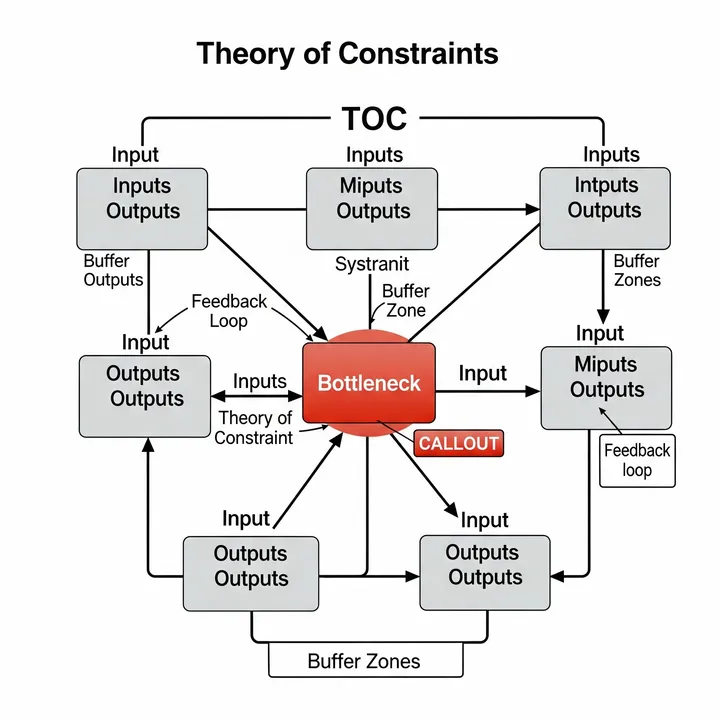
"TOC—Theory of Constraints—is a framework for finding the one point (the bottleneck) that stops the overall flow and concentrating there to optimize the whole," I explained. "The key is not trying equally hard everywhere. The whole's throughput is determined by the most clogged point. No matter how much you streamline elsewhere, the flow won't speed up. It's the tool that finds the constraint and widens it."
"Let's measure the current cost first," Gemini said, opening ROI Polygraph, and entered the data Suda had provided.
"The monthly cost is in," Gemini read out. "In-house hours for LINE inquiry handling (400–500 a day) average 320 hours a month; at ¥3,500 an hour, that's ¥1,120,000 a month. Concentrated phone handling and overtime from the Monday skew average ¥480,000 a month. Quality variance and training cost from person-dependent inquiry handling average ¥360,000 a month. The projected increase in per-location staffing cost when expanding branches averages ¥420,000 a month. Lost opportunity from response delays and customer churn from leaving the bottleneck untouched averages ¥340,000 a month. The total is ¥2,720,000 a month—roughly ¥32.64 million a year."
Suda stared at the figures. "I'd only seen 'everyone is busy.' I never imagined a clog at one point was weighing down the whole this much."
"Then let's design it with TOC," I continued.
[Identify the constraint—Find the one point that's clogged]
"First, we identify the constraint stopping the flow," Claude said. "Trace the work flow and LINE inquiry handling is the overall bottleneck. Its processing speed determines the whole in-house capacity. The clog is here."
[Exploit the constraint—Use the bottleneck to the fullest]
"Next, we use that constraint to the fullest," Gemini continued. "We replace routine inquiries with an AI chatbot, and people concentrate only on handling that requires judgment. We don't put wasteful load on the bottleneck. We use the constraint to its maximum."
[Subordinate the whole—Flow to match the constraint]
"After the constraint, we match the whole to it," I continued. "Complex inquiries the AI can't handle are automatically routed to dedicated staff. We stop person-dependence and subordinate the whole to the constraint's processing. The flow arranges itself to match the clog."
[Elevate the constraint—Widen the clog with AI]
"Finally, we widen the constraint itself," Claude continued. "We lift throughput with the AI chatbot and resolve the bottleneck. When expanding branches, deploy the same AI system uniformly and you can trim each location's staff. Widen the clog and the whole speeds up."
[Estimating the payback]
"Let's run the numbers with ROI Proposal Generator," Gemini proposed.
- Initial cost: AI chatbot build, automatic routing of complex inquiries, phone-handling support, and a unified per-location template—¥6,100,000 total
- Monthly cost: System operations and ongoing model updates combined—¥260,000 a month
- Monthly savings: Bottleneck resolved by automatic inquiry response = ¥720,000 a month; person-dependence eliminated by routing = ¥340,000 a month; per-location staffing optimized = ¥360,000 a month; response delays resolved = ¥260,000 a month; ¥1,680,000 a month total
- Net monthly savings: ¥1,680,000 − ¥260,000 = ¥1,420,000 a month
- Payback period: ¥6,100,000 ÷ ¥1,420,000 = about 4.3 months
"Payback in just over four months," Gemini summarized. "What works is widening from the one clogged point rather than streamlining everything equally. No matter how fast you make everything but the bottleneck, the whole doesn't change. Because you find the constraint and widen it, the whole in-house flow speeds up. The investment doesn't whiff."
Suda said, checking the figures, "I'd been trying to reduce everyone's busyness uniformly. Widen the clog at one point and the whole moves."
"TOC is the tool that finds the one clogged point and widens it," I replied.
Chapter 3: A Rollout Plan That Widens from the Constraint
"Let me lay out the approach," I said, standing at the whiteboard.
"Month 1—analyze the work flow and identify the bottleneck. Month 2—design the AI chatbot and fix the policy for exploiting the constraint. Months 3–4—build the chatbot and develop automatic routing for complex inquiries. Month 5—pilot operation and measure the bottleneck's throughput. Month 6—full operation and effect verification. Month 7 onward—unified AI-system deployment for branch expansion and optimizing per-location staffing."
"Can AI really handle the inquiries?" Suda asked, to confirm.
"It can handle them," Claude replied. "Everyone is busy because people are holding even the routine inquiries. With TOC, identify the constraint, route routine to AI and judgment-requiring ones to dedicated staff. Wasteful load stops falling on the bottleneck. Widen one point and the 30 people's hands free up."
Suda said, taking notes, "Before reducing the whole uniformly, find the clog and widen it. I can see the order now."
Chapter 4: The Day the Clog Widened
Nine months later, a report arrived from Suda.
LINE inquiry handling grew much lighter after the AI chatbot was introduced. "AI now gives a first response to most of the 400-plus inquiries a day. People can face only what requires judgment," Suda had written.
Person-dependence also headed toward resolution. Automatic routing of complex inquiries reduced the skew toward veterans. "'Only that person understands it' went down. Whoever takes it can handle it uniformly," the report said.
The biggest change appeared in how busyness was grasped. From thinking everyone was uniformly busy, it changed to a state of seeing the one clogged point and acting. "We'd been spinning our wheels trying to reduce everyone's load uniformly. Once we narrowed the constraint to one point and widened it, the whole flow sped up," Suda had written.
The outlook for branch expansion also changed. With a unified AI system, a path to trimming each location's staff came into view. "The premise of placing a large headcount per location collapsed. Align the AI and you can run it with a small team," the report said.
As a secondary effect, the way improvement was pursued changed. The idea of finding one clog and widening it took root on the floor. "We stopped trying hard at everything. We came to look first for where the constraint is," Suda had written.
At the end of his report, he wrote: "I thought the staffing-agency trouble was a labor shortage. But the real problem was assuming everyone was busy and not seeing the one clogged point. The moment we identified the constraint with TOC, where to widen to move the whole got decided. Before trying hard at everything, finding the clog came first."
The day a company that thought everything was busy became a company that could find and widen the one clogged point, operational efficiency had changed from uniform improvement of the whole into a design that focuses on the constraint and widens the clog with AI, the report noted.
"Operational-efficiency requests usually come in the form of 'everyone is busy.' But no matter how evenly you streamline everything, the flow won't speed up. The whole's throughput is determined by the most clogged point. What TOC asks is the bottleneck that is the constraint. Find it, exploit it, subordinate the whole, and widen it. The day a company that thought everything was busy could find the clog, what changed wasn't the AI tool but the very perspective that looks at one point rather than the whole and widens it."
Related Files
Tools Used
- ROI Polygraph — Visualizing inquiry-handling hours, person-dependence cost, and lost opportunity from response delays
- ROI Proposal Generator — Payback simulation for AI efficiency in staffing-agency operations starting from the Theory of Constraints


