
ROI Case File No.600: They Said They Wanted AI, but How They Work Today Had Never Been Recorded

They Said They Wanted AI, but How They Work Today Had Never Been Recorded
Chapter 1: They Want AI-Driven Efficiency, but Don't Know Where to Put It
"We want to use AI in our aviation-related operations."
Akira Kirokutani, representative director of AeroInnovate, said this as he laid out the situation. The company handles ground support at airports. "Air travel demand is growing. Meanwhile the workforce is shrinking. Efficiency is urgent. We're looking for a company with AI expertise, but we have no AI knowledge ourselves, and even after hearing them out we can't judge where to put it."
"Which operation takes the most manpower right now?" Claude asked.
"...By feel, flight assignment, equipment inspection records, and shift handovers," Kirokutani answered. "Handovers especially are badly personalized. When a veteran is off, the day's arrangements come apart. But exactly how much time each of these eats, we can't say precisely."
"Have you recorded how those operations are performed today?" I confirmed.
"...We haven't recorded it," Kirokutani answered. "All I've thought about is bringing in AI. Who does what, when, and in what order. We've never written it out."
"If the current way isn't recorded, you can't decide what to hand over either," I replied. "Let's break this down with RCD."
Chapter 2: RCD Asks—Record and Check Before You Move
"This case calls for RCD."
Claude wrote "Record / Check / Do" on the whiteboard.
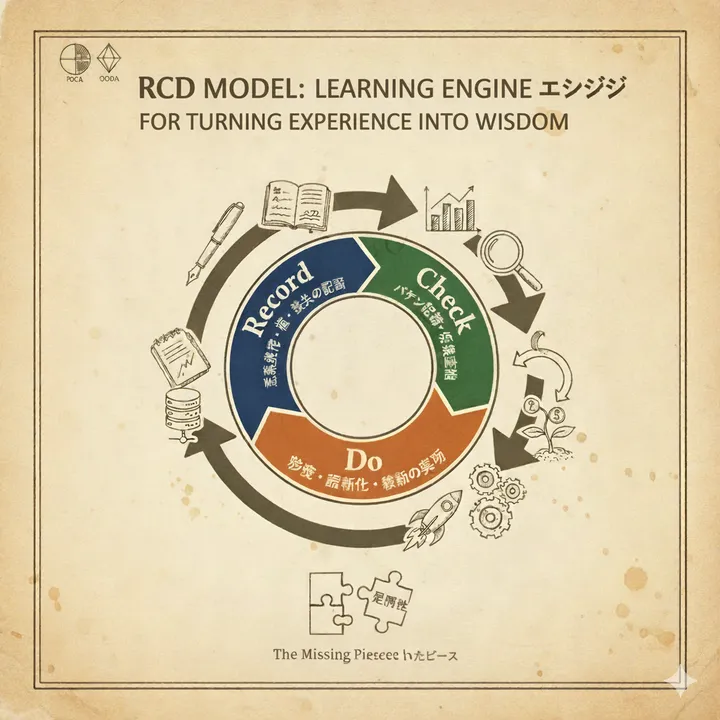
"RCD—Record, Check, Do—is a three-stage framework that first records the current state, then reconciles that record to confirm it, and only then moves," I explained. "The crux is not starting from execution. AI deployment belongs to the 'do' stage. Without a record, you can't say how much can be handed over, nor whether things improved after handing it over. The foundation for judging whether a vendor's proposal is right is also the record."
"First, let's measure the current cost," Gemini said, opening ROI Polygraph. The data Kirokutani had provided went in.
"The monthly cost is out," Gemini read off. "Labor for adjusting flight assignments, producing inspection records, and preparing handover materials averages 190 hours a month; at ¥3,700 an hour, that's ¥703,000 a month. Disrupted arrangements and delays when a specific person is absent, caused by personalization, average ¥440,000 a month. Missed communications and re-confirmation, because records are split between paper and word of mouth, average ¥360,000 a month. Increased backup shifts and overtime driven by the labor shortage average ¥340,000 a month. Stalled AI investment decisions, from the absence of a grasp of the current state, average ¥300,000 a month. Total: ¥2,143,000 a month. Annualized, roughly ¥25,720,000."
Kirokutani stared at the figures. "I was only looking at the labor shortage. Once you add the disruption on days a veteran is off, and the deliberation cost frozen because nothing gets decided, it comes to this much."
"Then let's design it with RCD," I continued.
[Record—write out how it's done today, as it is]
"First, record," Claude said. "How assignments are decided, how inspection records are written, what in the handover relies on speech. Write out the present state without inserting improvements. The judgments a veteran performs inside their head are exactly what needs writing out. If this is empty, there's nothing to hand to an AI."
[Check—reconcile the record and see the boundary of what can be delegated]
"Next, check," Gemini continued. "Arrange the procedures you wrote out by frequency, time, and difficulty of judgment. The ones repeated daily with routine judgment can be delegated. Judgments involving safety, and those with many exceptions, stay with people. Decide the boundary first and you can tell a good proposal from a bad one."
[Do—move from inside the boundary]
"After check comes do," I continued. "Transcription and routine checks on inspection records, automatic generation of handover materials. Move in order from inside the boundary. Don't put every operation onto AI at once. The results of what you moved feed back into the record."
[Iterate—take the record after moving as well]
"Last, iterating," Claude continued. "Because you have a record from before deployment, you can compare it to the record after. If you can say how many hours were saved, the next investment gets approved. Take the record not only before you start but after you move. The three stages don't end in one pass—they cycle."
[Simulating the investment recovery]
"Let's run the numbers with ROI Proposal Generator," Gemini proposed.
- Initial cost: Recording current operations and writing out procedures, designing the delegation boundary, implementing inspection-record support and handover-material generation, integrating with existing systems, and on-site training—¥5,100,000 in total
- Monthly cost: AI platform usage plus ongoing operation and maintenance—¥240,000 a month
- Monthly savings: Automation of inspection-record production and handover preparation = ¥490,000 a month (assuming a 70% reduction), prevention of disrupted arrangements by resolving personalization = ¥360,000 a month, elimination of missed communications and re-confirmation = ¥280,000 a month, reduction of backup shifts and overtime = ¥260,000 a month—¥1,390,000 a month in total
- Net monthly savings: ¥1,390,000 − ¥240,000 = ¥1,150,000 a month
- Payback period: ¥5,100,000 ÷ ¥1,150,000 = approximately 4.4 months
"That's a payback of a little over four months," Gemini summarized. "What works is that you don't enter through deployment—you enter through the record. Consult a vendor with no record, and the proposal comes back shaped to whatever they're good at, with no way to compare. Because the boundary is set, you can evaluate proposals. The investment doesn't swing at air."
Kirokutani looked over the numbers. "I thought we couldn't judge because we lack AI knowledge. What we lacked wasn't AI knowledge—it was a record of our own operations."
"RCD is a tool for recording and checking before moving," I replied.
Chapter 3: A Deployment Plan That Enters Through the Record
"Let me lay out the approach," I said, standing at the whiteboard.
"Month one—record current operations and write out the veterans' judgments. Month two—organize by frequency and difficulty of judgment, and fix the delegation boundary. Months three and four—implement inspection-record support and validate it on site. Month five—automatic handover-material generation and integration with existing systems. Month six—take the post-deployment record and compare it against the pre-deployment one. Month seven onward—revise the boundary and extend to flight-assignment support."
"Wouldn't it be faster to leave it to a company that knows this well, rather than spend two months recording?" Kirokutani confirmed.
"Choosing who to leave it to also requires a record," Claude replied. "If you can't hand over the current state, the proposal gets built on their assumptions. Even with three quotes in hand, differing premises make them incomparable. With a record, they line up on the same ground—and you can judge for yourself whether things improved afterward. Holding your own current state comes before finding someone knowledgeable."
Kirokutani took notes as he spoke. "Record today before bringing in AI. I can see the sequence now."
Chapter 4: The Day the Records Came Together and the Boundary Was Set
Ten months later, a report arrived from Kirokutani.
Inspection records changed dramatically once the support feature went in. "What used to be handwritten and then written out cleanly now takes only a check. The time left over after a job shortened directly," Kirokutani wrote.
Handovers stabilized too. What had relied on speech now remains automatically as a document. "Even on days a veteran is off, the arrangements no longer come apart. Whoever comes in, the same procedure runs," the report said.
The largest change showed up in how deliberations began. A state of entering through deployment became a state of entering through the record. "We used to go and ask what AI can do. Now we present our record first and then ask. The time it takes for a conversation to click is completely different," Kirokutani wrote.
They could also judge the effect. Having a pre-deployment record did it. "We stopped ending at 'it feels better.' Because we can produce how many hours were saved, the next investment goes through more easily," the report said.
As a side effect, the veterans' experience took form. The judgments in their heads got written out. "The judgment of people who retire in a few years is now on paper. We started from a conversation about AI, and the most valuable thing turned out to be that," Kirokutani wrote.
The final line of Kirokutani's report read: "I thought the trouble with AI was that we had no expertise. But the real problem was that we said we wanted AI while how we work today had never been recorded. The moment we recorded and checked with RCD, both what to delegate and what not to delegate were decided. Before deploying, recording came first."
The day a company whose current work had never been recorded became a company that could record and check before moving, AI deployment in operations had changed from hunting for a knowledgeable vendor into a design that records the present state and discerns the boundary, the report noted.
"Consultations about AI deployment usually arrive in the form of 'we're looking for a company that knows this well.' But there is a question to ask before you look. Has how you work today been recorded? What RCD asks is record and check, and then do. With a record, proposals line up on the same ground and you can judge the effect for yourself afterward. The day a company that lamented its lack of expertise could record its present state, what changed was not the volume of AI knowledge but the very perspective of writing out today before moving."
Related Files
Tools Used
- ROI Polygraph — Visualizing labor for assignment adjustment, inspection records, and handover preparation, plus disrupted arrangements from personalization and backup shift cost
- ROI Proposal Generator — Investment-recovery simulation for AI deployment in aviation operations built from recording the present state and designing the delegation boundary


