
ROI Case File No.559: 'We Saw Only the Current Glitch and Couldn't See What Lay Beyond'

We Saw Only the Current Glitch and Couldn't See What Lay Beyond
Chapter 1: Crushing the Glitch in Front of Us, Over and Over
"We're looking for a company that can revamp a handheld-terminal integration app we built with a no-code tool."
Takuya Hayama, in charge of DX at TechSolutions, described his situation as he spoke. His company runs handheld-terminal management at its Okayama plant. "It's been about a year since we moved from visual checks and handwriting to handheld-terminal management. Traceability improved, but as we ran it, revamps and feature additions became necessary. For our non-engineer in charge to fix it alone, it's already at the limit."
"What kind of glitches are coming up now?" Claude asked.
"Operation mistakes cause mislabeled prints. There are too many label types, so the floor gets confused. The opening-date management calculation throws errors," Hayama answered. "We're crushing the glitches in front of us each time, but we can't keep up."
"Beyond the glitches in front of you, do you see the problems you'll hit further ahead?" I asked, to confirm.
"...I don't," Hayama answered. "I'm at full stretch just fixing what's troubling us now. Come to think of it, the Excel row-count limit is approaching and we want to add more QR-code information, but the future has been pushed back. We saw only the near and couldn't see what lay beyond."
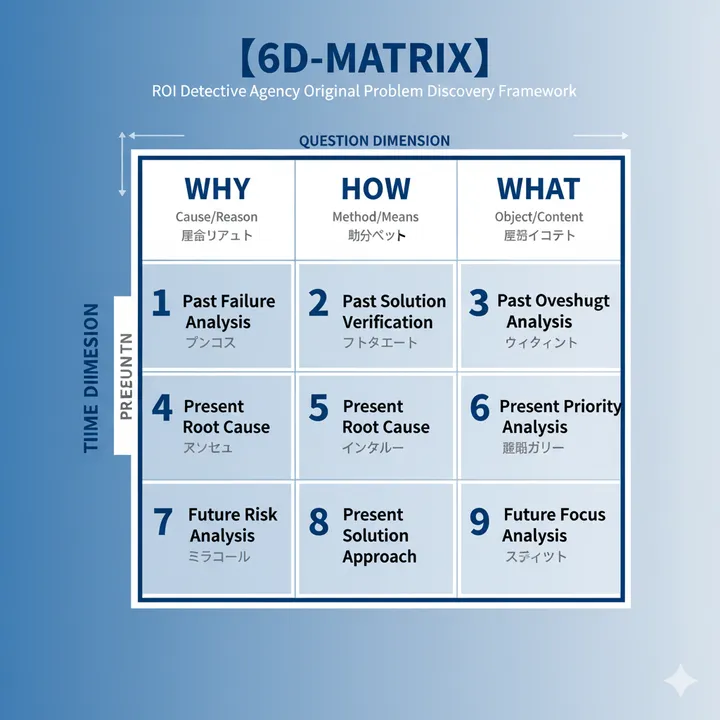
"Chase only the current glitches and you'll repeat the same thing," I replied. "Let's break it down with 6D_MATRIX."
Chapter 2: 6D_MATRIX Asks—See Across Six Dimensions
"This case calls for 6D_MATRIX."
Claude wrote "Present, Past, Future, WHY, HOW, WHAT" on the whiteboard.
"6D_MATRIX—six-dimensional matrix—is a framework for seeing a problem three-dimensionally across the six dimensions of Present, Past, Future, WHY, HOW, and WHAT," I explained. "The key is not seeing only the current glitch. Crush only the symptom in front of you (Present) and, unless you see why it happens (WHY) and how it goes from here (Future), it recurs. See across six dimensions and you can do a revamp that isn't a stopgap. It's that kind of tool."
"Let's measure the current cost first," Gemini said, opening ROI Polygraph, and entered the data Hayama had provided.
"The monthly cost is in," Gemini read out. "Rework and re-work hours from operation mistakes and mislabeled prints average 150 hours a month; at ¥3,800 an hour, that's ¥570,000 a month. Floor confusion and checking hours from too many label types average ¥360,000 a month. Disposal and complaint risk from calculation errors in opening-date management average ¥320,000 a month. Stalled revamps and external dependence from the limits of non-engineer handling average ¥400,000 a month. The expected value of data-management breakdown risk from the approaching Excel row-count limit averages ¥280,000 a month. The total is ¥1,930,000 a month—roughly ¥23.16 million a year."
Hayama stared at the figures. "I thought it was just the glitches in front of us. Once you include the revamp stalling itself and the data-breakdown risk ahead, I never imagined it would be this much."
"Then let's design it with 6D_MATRIX," I continued.
[Present—Line up the glitches happening now]
"First, we line up the present glitches," Claude said. "Mislabeled prints from operation mistakes, confusion from too many label types, opening-date calculation errors, insufficient QR-code information—we write out what's happening now without omission."
[Past—Trace where the mechanism came from]
"Next, we trace the past," Gemini continued. "Less than a year since moving from visual checks and handwriting to handheld management. With the rushed migration, where did the after-the-fact strain remain? See the history and the root of the glitches becomes clear."
[Future—See the wall you'll hit ahead]
"After the past, we see the future," I continued. "You want to expand QR-code information to six items. Before reaching the Excel row-count limit, data management needs revisiting. Even if it isn't a problem now, we factor in the wall you'll surely hit soon."
[WHY—Ask why you can't fix it yourselves]
"Changing dimension, we ask WHY," Claude continued. "Why can't you fix it yourselves? A non-engineer is handling it, short on specialist knowledge. There's a lot of time-consuming work. Without grasping the cause, even a revamp returns to the same wall."
[HOW—Decide the policy for how to fix]
"After WHY, we decide HOW," Gemini continued. "Someone with specialist knowledge intervenes, revamps the system, and adds features. We set a policy to fix from the root, not a stopgap."
[WHAT—Define what to rebuild]
"Finally, we define WHAT," I continued. "A user-friendly interface that reduces operation mistakes, a revisit of the label-management system, automatic opening-date calculation, and more efficient data management. Through the six dimensions, we fix the targets to rebuild."
[Estimating the payback]
"Let's run the numbers with ROI Proposal Generator," Gemini proposed.
- Initial cost: No-code app revamp, label-management system revisit, automatic opening-date calculation, QR-code six-item expansion, and data-base redesign—¥4,900,000 total
- Monthly cost: System operations and ongoing maintenance combined—¥200,000 a month
- Monthly savings: Operation mistakes and misprints reduced = ¥520,000 a month; label confusion resolved = ¥320,000 a month; automatic opening-date calculation = ¥300,000 a month; external dependence reduced = ¥360,000 a month; ¥1,500,000 a month total
- Net monthly savings: ¥1,500,000 − ¥200,000 = ¥1,300,000 a month
- Payback period: ¥4,900,000 ÷ ¥1,300,000 = about 3.8 months
"Payback in just under four months," Gemini summarized. "What works is revamping by seeing the past and future, not just crushing the current glitch. Fix only the present and it recurs. Because you see across six dimensions and factor in the data-breakdown wall ahead, it doesn't become a stopgap. The investment doesn't whiff."
Hayama said, checking the figures, "I'd been crushing the glitches in front of me each time. Seen across six dimensions, you can factor in the wall you'll hit ahead."
"6D_MATRIX is the tool that sees a problem three-dimensionally, not just now," I replied.
Chapter 3: A Rollout Plan That Adjudicates Across Six Dimensions
"Let me lay out the approach," I said, standing at the whiteboard.
"Month 1—six-dimensional problem analysis, washing out the present glitches and the future wall. Month 2—pin down WHY and fix the revamp policy (HOW). Months 3–4—revamp the interface and revisit the label-management system. Month 5—automatic opening-date calculation, QR-code expansion, and data-base redesign. Month 6—pilot operation and effect verification. Month 7 onward—continuous revisiting of data management and settling in the revamp operations."
"Won't another glitch come up again right away?" Hayama asked, to confirm.
"Recurrence will go down," Claude replied. "Glitches come up one after another because you're crushing only the present symptom. With 6D_MATRIX, grasp the past history and WHY and revamp with the future wall factored in. Because you fix from the root and look ahead, you don't return to the same problem. The Excel row-count limit, too, you can act on before hitting it."
Hayama said, taking notes, "Before crushing what's in front, see the past and future. I can see the order now."
Chapter 4: The Day What Lay Beyond Came into View
Nine months later, a report arrived from Hayama.
Mislabeled prints from operation mistakes dropped sharply after the interface revamp. "Mistakes caused by hard-to-use screens went down once we fixed the screen. Label types were organized, and the floor's confusion settled," Hayama had written.
The opening-date management calculation errors also vanished. With automatic calculation introduced, hand-calculation mistakes disappeared. "Things that became disposal or complaints from calculation mistakes now come out automatically and correctly," the report said.
The biggest change appeared in the range they saw. From chasing only the current glitch, it changed to a state of factoring in the wall ahead. "I was at full stretch crushing what was in front. Seen across six dimensions, the future wall of the Excel row-count limit came into view, and we could act before hitting it," Hayama had written.
External dependence dropped, too. The revamp policy settled, and the range they could handle in-house widened. "The tightrope of outsourcing at every glitch went down," the report said.
As a secondary effect, the way problems were viewed changed. The idea of seeing three-dimensionally, not just now, took root on the floor. "We stopped chasing only the symptom in front. We came to see why it happens and how it goes from here," Hayama had written.
At the end of his report, he wrote: "I thought a tool revamp meant fixing the glitches in front of us. But what was truly needed was seeing three-dimensionally, including past and future and WHY. The moment we widened to six dimensions with 6D_MATRIX, the wall we'd hit ahead came into view. Before crushing what was in front, seeing beyond came first."
The day a company that saw only the current glitch and couldn't see what lay beyond became a company that could adjudicate problems three-dimensionally, the tool revamp had changed from a stopgap treatment of symptoms into a design that foresees across six dimensions, the report noted.
"Revamp requests usually come in the form of 'we want to fix the glitches showing now.' But there's something to ask before crushing what's in front. Why does it happen, and how does it go from here? What 6D_MATRIX asks is the six dimensions of Present, Past, Future, WHY, HOW, and WHAT. See three-dimensionally, not just now, and you can factor in the wall you'll hit ahead. The day a company that saw only the current glitch could see what lay beyond, what changed wasn't the tool performance but the very perspective that sees a problem three-dimensionally, not just now."
Related Files
Tools Used
- ROI Polygraph — Visualizing operation-mistake rework hours, external dependence from stalled revamps, and data-breakdown risk
- ROI Proposal Generator — Payback simulation for a no-code tool revamp starting from six-dimensional problem analysis


