
ROI Case File No.594: They Wanted to Fix the Price Variance, but Had Never Asked Why It Differed by Person

They Wanted to Fix the Price Variance, but Had Never Asked Why It Differed by Person
Chapter 1: They Want Quotes Aligned, but Can't Settle on How
"We want to bring AI into how we produce quotations."
Kan Tomoda, president of QuantisPrint, said this as he laid out the situation. A printing company founded twenty-five years ago. "We issue more than 5,400 quotations a year. We have six salespeople, and for similar jobs the figures they quote differ by person. We've had awkward moments when a customer found out later. I want it standardized."
"Where does the difference come from?" Claude asked.
"Experience, I think," Tomoda answered. "Printing has fine-grained specifications. Paper type, number of colors, folds, finishing, quantity brackets, how much slack is in the deadline. The veterans quote by feel. The younger ones look up tables. Sometimes the veterans come out lower, sometimes higher. I just want it aligned."
"Have you asked those veterans why they arrived at that figure?" I confirmed.
"...I haven't," Tomoda answered. "All I've thought about is aligning it. What they look at, where they add and where they subtract. I've never heard it from their own mouths."
"Align without asking why, and you erase the judgments you need," I replied. "Let's break this down with DESIGN THINKING."
Chapter 2: DESIGN THINKING Asks—Listen First, Then Build
"This case calls for DESIGN THINKING."
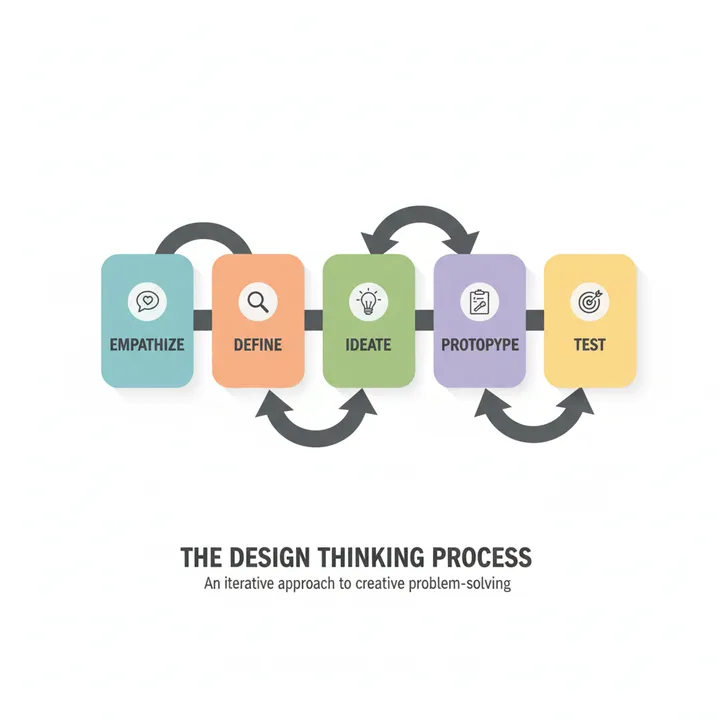
Claude wrote "Empathize / Define / Ideate / Prototype / Test" on the whiteboard.
"DESIGN THINKING is a framework that observes the people who use something, restates the problem, and settles the shape while iterating on prototypes," I explained. "The crux is not deciding the right answer in advance. Declare the variance abnormal and force it into a table, and you also erase the judgment behind a discount and the instinct that prices in an unreasonable deadline. Listen first, then distinguish which judgments should be kept and which differences are merely mood."
"First, let's measure the current cost," Gemini said, opening ROI Polygraph. The data Tomoda had provided went in.
"The monthly cost is out," Gemini read off. "Labor for producing quotations, confirming specifications, and recalculating averages 180 hours a month; at ¥3,700 an hour, that's ¥666,000 a month. Lost deals and excessive discounting caused by price differences between representatives average ¥420,000 a month. Rework and absorbed cost differences caused by missed specification details average ¥360,000 a month. Delayed responses while waiting on a veteran to confirm average ¥320,000 a month. The inability to reuse past quotations, because they're scattered in individuals' hands, averages ¥280,000 a month. Total: ¥2,046,000 a month. Annualized, roughly ¥24,550,000."
Tomoda stared at the figures. "I was only looking at the preparation burden. Once you add the over-discounting and the jobs lost to waiting on confirmations, it comes to this much."
"Then let's design it with DESIGN THINKING," I continued.
[Empathize—hear from the person why they set that figure]
"First, empathize," Claude said. "Have each of the six open a recent quotation and ask where the number came from. Paper stock on hand, an opening in the machine schedule, how reliably the customer pays. Materials that appear nowhere in the tables will always come out. Build without asking, and all of it disappears."
[Define—restate the variance by type]
"Next, define," Gemini continued. "Separate the differences you heard. Differences with grounds—a discount that reflects an opening in the machine schedule. Differences to erase—simple calculation mistakes and drift in market sense. The problem isn't that prices don't align; it's that grounded differences and ungrounded ones are mixed together."
[Ideate—make twenty-five years of quotations the material]
"After define comes ideate," I continued. "You have twenty-five years of quotation and order records. Connect specification, price, and won-or-lost, and the price bands that win come out. What the AI should produce is not a single correct answer, but a grounded reference figure and a warning when something falls outside it."
[Prototype and test—make it produce, then have it corrected]
"Last, prototype and test," Claude continued. "In a paid environment, have it produce several dozen real quotations and have the six score them. For every case a veteran calls wrong, ask again why it's wrong. The more you iterate, the more of the judgment worth keeping moves into the system. Not finishing it in one pass is the premise of this method."
[Simulating the investment recovery]
"Let's run the numbers with ROI Proposal Generator," Gemini proposed.
- Initial cost: Interviews with the six salespeople, preparing twenty-five years of quotation data, building the pricing AI, implementing the specification-entry screen, prototype iteration, and training—¥4,900,000 in total
- Monthly cost: AI usage plus ongoing operation and maintenance—¥220,000 a month
- Monthly savings: Reduced labor for producing and recalculating quotations = ¥470,000 a month (assuming a 70% reduction), suppression of lost deals and excessive discounting from price differences = ¥340,000 a month, prevention of rework from missed specifications = ¥280,000 a month, elimination of response delays from waiting on confirmations = ¥240,000 a month—¥1,330,000 a month in total
- Net monthly savings: ¥1,330,000 − ¥220,000 = ¥1,110,000 a month
- Payback period: ¥4,900,000 ÷ ¥1,110,000 = approximately 4.4 months
"That's a payback of a little over four months," Gemini summarized. "What works is that you don't decide standardization first—you listen first. Build a table and impose it, and the veterans won't use it while only the juniors are bound by it. Move the reasoning behind the judgment into the system, and all six use it. The investment doesn't swing at air."
Tomoda looked over the numbers. "I thought bringing in a good AI would align things. Without asking why, you can't even decide what to align."
"DESIGN THINKING is a tool for listening first and building after," I replied.
Chapter 3: A Deployment Plan That Listens Before It Builds
"Let me lay out the approach," I said, standing at the whiteboard.
"Month one—interview the six salespeople and write out the grounds behind recent quotations. Month two—classify the differences and prepare twenty-five years of data. Months three and four—prototype the pricing and run it in parallel on live jobs. Month five—adjust based on the six people's scoring and implement the specification-entry screen. Month six—switch over all quotations and verify results. Month seven onward—feed order outcomes back in and extend to meeting minutes and proposals."
"Wouldn't it be better to build quickly rather than spend two months on interviews?" Tomoda confirmed.
"Build without listening and you build twice," Claude replied. "A quotation forced into a table is one the veterans won't use. If it isn't used, only the juniors are bound, the variance remains, and all you've added is resentment on the floor. Twenty-five years of judgment can't be extracted unless you ask. Gathering the material comes before speed of building."
Tomoda took notes as he spoke. "Ask why they differ before aligning them. I can see the sequence now."
Chapter 4: The Day They Asked Why and the Prices Aligned
Ten months later, a report arrived from Tomoda.
Quotation work changed dramatically once the AI was applied. "Enter the specification and a grounded figure comes out. The hours juniors spent pulling table after table are gone," Tomoda wrote.
The price variance settled too. Only the ungrounded differences disappeared; the grounded ones remained, with a warning attached. "Discounts that reflect an opening in the machine schedule can still be issued. But now the reason for the reduction stays on record. The awkward conversations afterward are gone," the report said.
The largest change showed up in how they thought about standardization. A state of trying to make everything identical became a state of distinguishing the judgments to keep from the differences to erase. "I thought aligning meant forcing things into a table. Once we asked why, we found there are differences that must not be aligned," Tomoda wrote.
They also won the veterans' participation. Seeing their own judgment inside the system dissolved the resistance. "They'd assumed it would be taken away from them. Because we started with interviews, it became a story about handing their instincts down to the juniors," the report said.
As a side effect, the juniors developed faster. Having the grounds displayed on screen made it a teaching tool in itself. "Because the reason for the figure is shown, they can cover twenty-five years' worth in a few months," Tomoda wrote.
The final line of Tomoda's report read: "I thought the trouble with quotations was a gap in individual skill. But the real problem was that we wanted to fix the price variance and had never asked why it differed by person. The moment we listened with DESIGN THINKING, the differences to keep and the differences to erase separated. Before aligning, asking why came first."
The day a company that had never asked why its prices differed became a company that could move judgment into a system, quotation standardization had changed from forcing things into a table into a design that listens to the judgment of the people who quote and distinguishes the differences worth keeping, the report noted.
"Consultations about standardization usually arrive in the form of 'we want to align what differs by person.' But there is a question to ask before aligning. Have you asked the people themselves why it differs? What DESIGN THINKING asks is empathy, definition, and the iteration of prototypes. Listen, and the differences to erase separate from the judgments to keep. The day a company that had declared variance abnormal could ask why, what changed was not the accuracy of the AI but the very perspective of observing the user before building."
Related Files
Tools Used
- ROI Polygraph — Visualizing quotation labor, lost deals and excessive discounting from price differences, and response delays from waiting on confirmations
- ROI Proposal Generator — Investment-recovery simulation for quotation-AI deployment starting from interviews about the representatives' judgment


