
ROI Case File No.577 'The Burden Was Visible, but We Hadn't Reached the Bottom of Why'
The burden was visible, but we hadn't reached the bottom of why
- Chapter 1: The burden is heavy—but what do we fix to lighten it?
- Chapter 2: What the 5 Whys ask—stack "why" five times to reach the true cause
- Chapter 3: An implementation plan that reaches the true cause before acting
- Chapter 4: The day, reaching the bottom, the burden lightened
- Related Files
- Tools Used
Chapter 1: The burden is heavy—but what do we fix to lighten it?
"We want to use AI to make our operations efficient. I'd like a proposal from a company with a track record in staffing."
Toru Horikoshi, in charge of business promotion at TechBridge, described the situation. Theirs is a staffing business for housekeeping and babysitting. "LINE inquiries run 400 to 500 a day. Thirty in-house staff handle them, and the burden is heavy. On weekends the office is closed, so inquiries pile up on Monday. In the future we're also considering branch expansion—I want a structure where AI lets each branch run with one person."
"How are you trying to lighten the burden?" Claude asked.
"By considering whether to add people or automate with AI," Horikoshi answered. "I try to reduce the surface burden directly—the count is high, it piles up on Monday. But I've never dug down to the root of why there are so many inquiries."
"Have you dug into why the inquiries are so many, stacking 'why'?" I confirmed.
"…I haven't," Horikoshi answered. "I've only been looking at the surface burden. Reduce the count, disperse the pileup. But why it happens—I haven't reached the bottom."
"The burden is visible, but unless you reach the bottom of why, you can't play an effective hand," I replied. "Let's break it down with the 5 Whys."
Chapter 2: What the 5 Whys ask—stack "why" five times to reach the true cause
"This case calls for the 5 Whys."
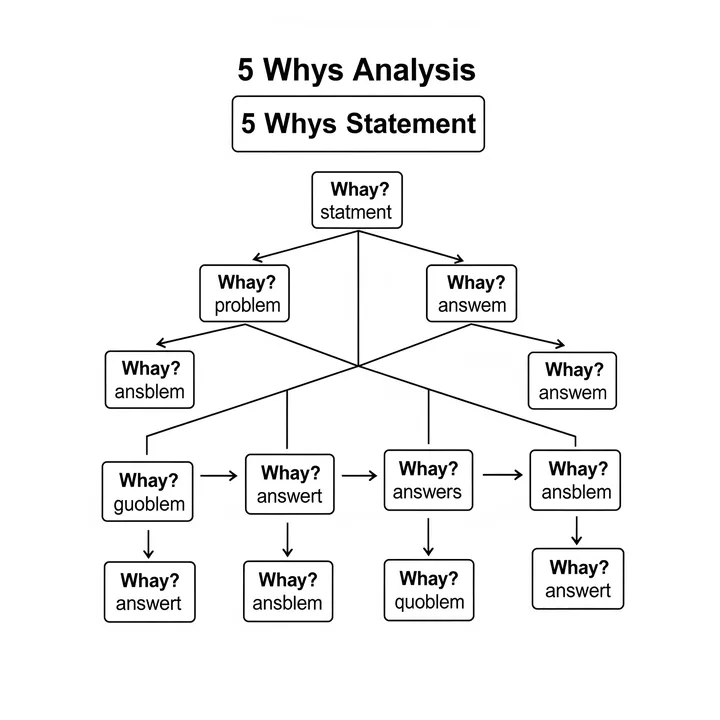
Claude wrote on the whiteboard: "Why? × 5."
"The 5 Whys—an analysis that stacks 'why' five times—is a framework that repeats 'why' from the surface problem to reach the true cause," I explained. "The crux is not stopping at the surface burden. Treat 'the count is high' and you end in symptomatic relief. Dig five times—why it's high, why that happens—and the root comes into view. You can play a hand that works on the true cause. It's a tool for reaching the bottom."
"First, let's measure the current cost," Gemini said, opening ROI Polygraph. He entered the data Horikoshi had provided.
"The monthly cost is out," Gemini read off. "Labor handling LINE inquiries averages 200 hours a month; at ¥3,500 an hour, that's ¥700,000 a month. Overtime and response delay from the Monday pileup average ¥400,000 a month. Inefficiency from duplication in individual handling averages ¥360,000 a month. Opportunity loss from the inability to respond on weekends averages ¥320,000 a month. The headcount-cost-increase risk at branch expansion averages ¥340,000 a month. The total is ¥2,120,000 a month—about ¥25.44 million a year."
Horikoshi stared at the figures. "I'd been watching only the high count. Once you add the cost of treating it without reaching why it's high, it comes to this much."
"Then let's design it with the 5 Whys," I continued.
[The first and second why—dig the surface of the burden]
"First, the first and second," Claude said. "Why is the burden heavy?—because there are 400 to 500 inquiries a day and thirty people handle them. Why so many?—because inquiries about the service span many kinds. Dig the surface burden one layer."
[The third and fourth why—dig the reason for individual handling]
"Next, the third and fourth," Gemini continued. "Why so many kinds?—because the service content is broad and the questions are detailed, requiring individual handling. Why is individual handling needed?—because each customer's needs and situation differ. Dig one more layer."
[The fifth why—reach the true cause]
"After the fourth, the fifth," I continued. "Why is a per-customer answer needed?—to raise customer satisfaction and keep their trust. Here's the root. The bottom of the burden lies in the point that answers tailored to individual needs are indispensable. We've reached the true cause."
[The move—aim AI at the true cause]
"Last, the move," Claude continued. "If the true cause is individual handling, use an AI chatbot to respond instantly to the many-kinds inquiries and automate the per-customer answer. Aim not at the surface count but at the root—individual handling. That's what connects to running a branch with one person."
[Estimating the payback]
"Let's run the numbers with the ROI Proposal Generator," Gemini proposed.
- Initial cost: 5 Whys analysis, AI-chatbot build, automation of individual handling, multi-store expansion design, and operational transition—¥5.6 million total
- Monthly cost: AI operation plus ongoing maintenance—¥240,000
- Monthly savings: automated inquiry handling = ¥580,000 (assuming a 70% reduction); leveling of the Monday pileup = ¥340,000; automation of individual handling = ¥300,000; efficiency of branch operation = ¥300,000; ¥1,520,000 a month total
- Net monthly savings: ¥1,520,000 − ¥240,000 = ¥1,280,000 a month
- Payback period: ¥5.6 million ÷ ¥1,280,000 = about 4.4 months
"A little over four months to recover," Gemini summarized. "What works is not stopping at the surface burden but reaching the bottom of why before playing a hand. Merely reducing the count is symptomatic relief. Aim AI at the true cause—individual handling—and it lightens from the root, and connects to one-person branch operation. The investment doesn't swing at empty air."
Horikoshi said as he checked the numbers. "I thought reducing the count would settle it. Unless you reach the bottom of why it's high, you end in symptomatic relief."
"The 5 Whys is a tool for stacking 'why' to reach the true cause," I replied.
Chapter 3: An implementation plan that reaches the true cause before acting
"Let me lay out the approach," I said, standing before the whiteboard.
"Month one—the true-cause analysis stacking 'why' five times and typing the inquiries. Month two—design the AI chatbot and define the scope of automating individual handling. Months three and four—build the chatbot and integrate with LINE. Month five—operational design with a view to multi-store expansion. Month six—trial run and effect verification. Month seven onward—establish the one-person branch structure and expand the scope of handling."
"Wouldn't it be faster to first play a hand that reduces the count?" Horikoshi confirmed.
"That's the pitfall," Claude replied. "A hand that reduces the count, without reaching why it's high, ends in symptomatic relief and swells again. Reach the true cause—individual handling—with the 5 Whys, and you can aim AI there and lighten it from the root. Reaching the bottom is the shortcut to stopping the repetition."
Horikoshi said as he took notes. "Before reducing the surface burden, reach the bottom of why. I can see the order now."
Chapter 4: The day, reaching the bottom, the burden lightened
Ten months later, a report arrived from Horikoshi.
Inquiry handling lightened greatly after the AI introduction. "The 400 to 500 a day, AI began to answer instantly. The burden on the in-house staff eased visibly," Horikoshi wrote.
The Monday pileup eased too. With AI receiving on weekends as well, the tilt toward Monday leveled out. "On weekends when the office is closed, inquiries were handled automatically. The mountain no longer came on Monday," the report said.
The biggest change showed in how the problem was dug. From reducing the surface burden, they shifted to reaching the bottom of why. "I'd been stuck at 'reduce the count.' Once I dug why it's high five times, I saw the root was individual handling, and I could aim AI there," Horikoshi wrote.
Branch expansion came into view too. Automation of individual handling supported the one-person structure. "Because AI carries the individual answers, a path to running each branch with one person is laid," the report said.
As a side effect, the way problems were viewed changed. Rather than the surface symptom, the habit of digging the true cause took root. "I stopped ending at 'reduce the visible burden.' I began to dig why it happens down to the bottom," Horikoshi wrote.
At the end of Horikoshi's report was written: "I thought the efficiency trouble was the high number of inquiries. But the real problem was that the burden was visible while I hadn't reached the bottom of why. The moment I stacked 'why' five times with the 5 Whys, the true cause came into view. Before reducing the surface burden, reaching the bottom of why came first."
On the day a company where the burden was visible but that hadn't reached the bottom of why became a company that could act after reaching the true cause, operational efficiency had changed from treating the surface burden into a design that stacks 'why' five times to reach the true cause.
"A consultation about operational efficiency usually arrives in the form of 'we want to reduce the burden.' But before reducing the surface burden, there's something to ask. Have you reached the bottom of why it happens? What the 5 Whys asks is the true cause beyond five stacked 'whys.' Reach the bottom and you can work on the root instead of symptomatic relief. On the day a company where the burden was visible but that hadn't reached the bottom could reach the true cause, what changed was not the volume of handling but the very perspective of stacking 'why' to reach the true cause."
Related Files
Tools Used
- ROI Polygraph — visualizing inquiry-handling labor, Monday-pileup overtime, and duplication in individual handling
- ROI Proposal Generator — a payback simulation for AI-driven operational efficiency, starting from a move aimed at the true cause found by stacking 'why'


