
ROI Case File No.588: They Tried to Build from Nothing and Never Counted What They Already Had

They Tried to Build from Nothing and Never Counted What They Already Had
Chapter 1: They Want to Write Guidelines, but Their Hands Stop
"We're looking for a company to help us write guidelines for AI agents."
Idomu Yasuda of TechInsights's corporate planning department said this as he laid out the situation. "Our parent company set a group-wide policy to move forward with AI agents. That means we need internal guidelines. The trouble is, nobody here can write them."
"Where are you stuck?" Claude asked.
"First, we have no expertise," Yasuda answered. "We don't know what to write. And since the product hasn't been chosen yet, some people say there's nothing to write. The budget has to be spent within this fiscal year, by next March. Time is just draining away."
"Are there any rules or documents you already have internally that you could use?" I confirmed.
"...We haven't counted," Yasuda answered. "I assumed this was something you build from a blank page. Even though the parent company's policy and our information security regulations already exist. Take stock of what's there and add only what's missing—I hadn't been thinking that way."
"Try to build from nothing and the sheer volume stops your hands," I replied. "Let's break this down with KPT."
Chapter 2: KPT Asks—What Exists, What's Missing, What to Try
"This case calls for KPT."
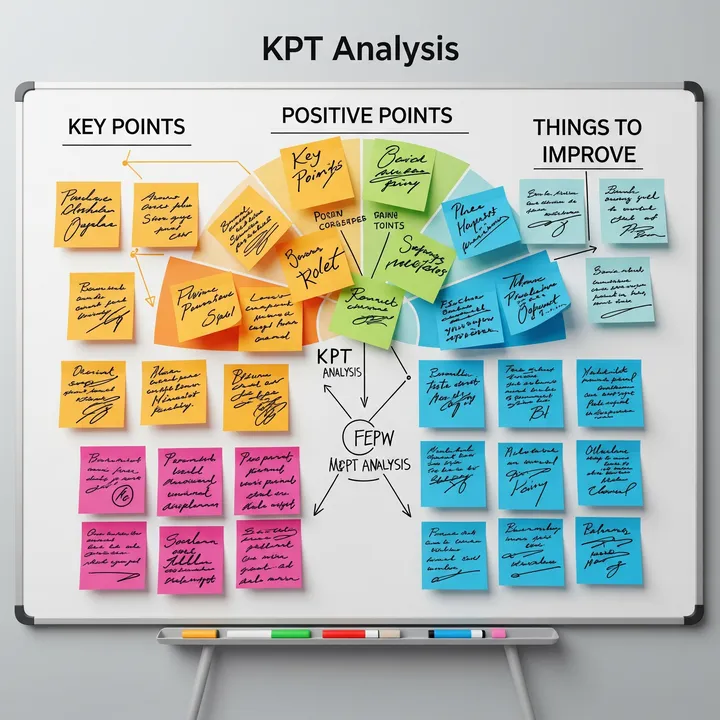
Claude wrote "Keep / Problem / Try" on the whiteboard.
"KPT—keep, problem, try—is a framework for sorting the present into three and deciding the next move," I explained. "The essence is not starting from a blank page. Count what already exists and functions, name what's missing, and shape it into something testable within this fiscal year. Split into three and the volume you need to write is smaller than you feared. And there is always a portion you can write even without the product decided."
"First, let's measure the current cost," Gemini said, opening ROI Polygraph. The data Yasuda provided went in.
"The monthly costs are out," Gemini read off. "Internal labor devoted to deliberating the guidelines averages 150 hours per month; at ¥4,000 per hour, that's ¥600,000 per month. Risk from AI being used individually with no policy in place averages ¥420,000 per month. Deliberation spinning its wheels from lack of expertise averages ¥360,000 per month. Selection stalled on the grounds that the product isn't decided averages ¥320,000 per month. The risk of unspent, expiring fiscal-year budget averages ¥340,000 per month. The total is ¥2,040,000 per month. Annualized, roughly ¥24,480,000."
Yasuda stared at the figures. "I was only looking at our inability to write it. Once you add the risk of everyone using AI without a decision, and the loss of budget disappearing, it comes to this much."
"Then let's design with KPT," I continued.
[Keep—Count what already exists]
"First, Keep," Claude said. "The group-wide policy your parent company set, the existing information security regulations, the rules for handling confidential information, this fiscal year's budget allocation. These already exist and are alive. Half the skeleton of the guidelines can be brought over from here. It isn't a blank page."
[Problem—Name what's missing, explicitly]
"Next, Problem," Gemini continued. "Three things are missing: AI-specific judgment criteria, internal expertise, and the premise that the product is undecided. Don't say vaguely that things are lacking—name them. Once named, the scope to outsource and the scope to hold internally separate."
[Try—Shape it into something testable within this fiscal year]
"After Problem, Try," I continued. "Don't wait for the product decision. Decide first on the principles common to any product—the range of information that may be entered, responsibility for verifying outputs, how records are kept. Product-specific settings become a branch you add once it's decided. Put this fiscal year's budget into building those principles and into internal training."
[Cycle—Rewrite the three every three months]
"Last, the cycle," Claude continued. "Guidelines are not completed in one pass. Every three months, rewrite what to keep, what the problems are, and what to try. The premises around AI keep changing, so regulations that go un-updated become dead letters fast. The mechanism for keeping it turning is part of the guidelines."
[Calculating the payback]
"Let's run the numbers with ROI Proposal Generator," Gemini proposed.
- Initial cost: Inventory of existing regulations, formulation of AI usage principles, drafting the product-independent portion of the guidelines, internal training and workshops, and designing the update process — ¥4,300,000 total
- Monthly cost: Guideline operation plus an ongoing help desk — ¥200,000 per month
- Monthly savings: Compression of deliberation labor = ¥420,000 per month (assuming a 70% reduction), elimination of AI usage risk from the absent policy = ¥340,000 per month, elimination of wheel-spinning from lack of expertise = ¥280,000 per month, elimination of stalling on the grounds of an undecided product = ¥260,000 per month — ¥1,300,000 per month in total
- Net monthly savings: ¥1,300,000 − ¥200,000 = ¥1,100,000 per month
- Payback period: ¥4,300,000 ÷ ¥1,100,000 = approximately 3.9 months
"A payback of just under four months," Gemini summarized. "What makes it work is not writing from a blank page, but counting what exists and then adding. Try to build from nothing and the volume overwhelms you, nothing starts, and this year's budget expires. Sort into three and the writing shrinks, and you can begin without waiting for the product. The investment doesn't swing at air."
Yasuda looked over the figures. "I thought we couldn't write it because we had no expertise. Count what exists, and only a part needs adding."
"KPT is a tool for sorting what exists, what's missing, and what to try," I replied.
Chapter 3: An Implementation Plan That Sorts into Three
"Let me lay out how to proceed," I said, standing at the whiteboard.
"Month one—inventory existing regulations and the parent company's policy, and fix the Keep. Month two—name what's missing and separate the scope for outside support. Months three and four—formulate product-independent AI usage principles. Month five—run internal training and workshops, and execute this fiscal year's budget. Month six—begin operation and complete the first rewrite. Month seven onward—add branches as the product is decided, and update on a three-month cycle."
"Wouldn't writing it after the product is chosen avoid rework?" Yasuda asked.
"Waiting costs more than the rework," Claude replied. "Employees will use AI in some form while the product is being decided. With no policy, that usage becomes established fact. Put the principles down first and you only add settings once the product is chosen. Deciding the principles comes before waiting for the product."
Yasuda took notes. "Before I start writing from nothing, count what exists. I can see the order now."
Chapter 4: The Day They Counted What Existed and Could Start Writing
Ten months later, a report arrived from Yasuda.
The guidelines had a skeleton within two months of the inventory. "Far more of the existing information security regulations were usable as-is than I imagined. What we actually wrote from scratch was only the AI-specific judgment criteria," Yasuda wrote.
The undecided-product barrier vanished too. Separating principles from settings removed the need to wait. "The excuse that we can't write because the product isn't chosen stopped holding. By the time it was chosen, we were in a state where we only had to add," the report said.
The largest change showed up in how they got started. From trying to build from a blank page, they moved to counting what existed and adding. "We were stuck at 'we have no expertise, so it's impossible.' Sorting into three showed that only a part was missing, and only that part needed outside help," Yasuda wrote.
The budget was executed within the fiscal year as well. Putting it into principles and training meant they didn't have to wait for product selection. "We avoided leaving budget to expire in March. It even helped with next year's request," the report said.
As a secondary effect, their handling of regulations changed. Not treating them as finished once written took root. "We stopped fixing things in place once decided. Now we rewrite what to keep, what the problems are, and what to try, every three months," Yasuda wrote.
At the end of Yasuda's report, he had written: "I thought the guideline problem was that we had no internal expertise. But the real problem was that we tried to build from nothing and never counted what we already had. The moment KPT sorted it into three, the amount to write became a realistic size. Before starting to write, counting what exists came first."
The day a company that had tried to build from nothing became a company that adds to what exists and keeps it cycling, AI guideline formulation had changed from writing on a blank page into a design that sorts what exists, what's missing, and what to try, and keeps them turning, the report noted.
"Guideline consultations almost always arrive in the form of 'we have no expertise, so we can't write them.' But before you start writing, there is something to ask. Have you counted what you already have? What KPT asks about is what to keep, what the problems are, and what to try. Sort into three and the writing shrinks, and you can move without waiting for the product. The day a company that had tried to build from nothing managed to count what it had, what changed was not the volume of internal expertise but the very perspective of adding to what already exists."
Related Files
Tools Used
- ROI Polygraph — Visualizing deliberation labor, AI usage risk from an absent policy, and budget-expiry risk
- ROI Proposal Generator — Investment-recovery simulation for AI agent guideline formulation driven by sorting what exists, what's missing, and what to try


