
ROI Case File No.592: They Kept Adding Sheets, but Never Traced the User's Day

They Kept Adding Sheets, but Never Traced the User's Day
Chapter 1: The Spreadsheets Have Hit Their Limit, but No Shape for the Rebuild
"I want to rebuild our production and inventory management."
Toru Tadorikawa, production management manager at TimberWorks, said this as he laid out the situation. The company processes and sells timber. "Right now we run on the free plan of Google Sheets. We're close to the storage ceiling, so we can't keep old data around. And the sheets have split into seventeen different files—nobody knows what's where."
"How did those seventeen come about?" Claude asked.
"We added one every time something hurt," Tadorikawa answered. "Someone said we needed a record of incoming logs—one sheet. Someone wanted to see yield—another sheet. Someone wanted drying stock kept separate—another sheet. We made one each time, and they all stayed. Edit permissions can't be split finely either, so someone re-sorts a sheet and breaks a row somewhere else. Daily reports get copied into Excel and saved again."
"Where in the floor's day do those seventeen get touched, and by whom?" I confirmed.
"...We haven't traced that," Tadorikawa answered. "All we've done is add sheets. From morning to evening, what the people on the floor look at, what they write, and who they hand it to next. We've never followed it end to end."
"Adding sheets without tracing the day only adds seams," I replied. "Let's break this down with JOURNEY."
Chapter 2: JOURNEY Asks—Trace the Day End to End
"This case calls for JOURNEY."
Claude wrote "Beginning / Middle / Friction / End" on the whiteboard.
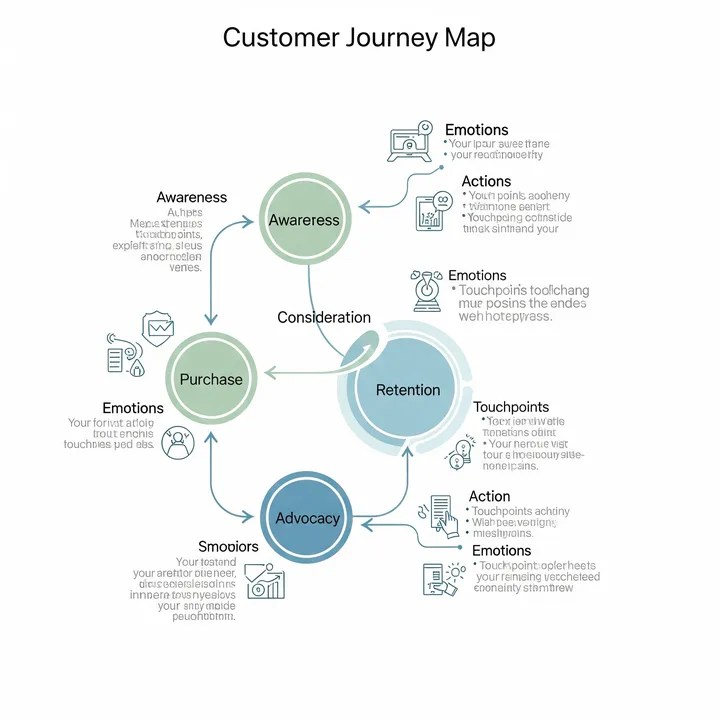
"JOURNEY—the journey map—is a framework that arranges a user's experience in chronological order and draws, in a single line, what happens where and where things jam," I explained. "The crux is not to think in a list of features. Count seventeen sheets and you still can't see the floor's day. Trace it end to end, from the morning intake to the evening report, and the seams where transcription happens and the places where people wait come into view. What you should build is right there."
"First, let's measure the current cost," Gemini said, opening ROI Polygraph. The data Tadorikawa had provided went in.
"The monthly cost is out," Gemini read off. "Labor for transcribing daily reports, saving them into Excel, and copying between sheets averages 170 hours a month; at ¥3,800 an hour, that's ¥646,000 a month. Discrepancies and rework caused by writing the same figure twice average ¥400,000 a month. Mis-operations and recovery caused by permissions that can't be separated average ¥340,000 a month. Reconciling inventory and process data across seventeen sheets averages ¥320,000 a month. Archiving and retrieving past data because of the storage ceiling averages ¥300,000 a month. Total: ¥2,006,000 a month. Annualized, roughly ¥24,070,000."
Tadorikawa stared at the figures. "I was only looking at the data-entry burden. Once you add recovering broken sheets and moving old data in and out, it comes to this much."
"Then let's design it with JOURNEY," I continued.
[Beginning—trace where the day starts]
"First, the beginning," Claude said. "The floor's day starts with receiving incoming logs. The species, grade, and quantity written there become the source of everything that follows that day. If the record at the starting point is handwritten, everything after it is a handwritten copy. Securing that first point comes first."
[Middle—see what happens at the handoff seams]
"Next, the middle," Gemini continued. "Sawing to drying, drying to processing, processing to shipping. Every time the process changes, the person changes, and there the sheet changes. Transcription only happens at seams. Draw lines connecting which of the seventeen straddle which seam, and the places that need filling narrow down."
[Friction—name the places where the same figure is written twice]
"After the middle comes friction," I continued. "Copying the daily report into Excel creates no value. Neither does recounting drying stock on a separate sheet. Writing twice always creates discrepancies, and discrepancies always create reconciliation. Name the friction, and the motions to be erased are decided."
[End—design what remains at the close of the day]
"Last, the end," Claude continued. "What should remain at the close of the day is a picture of inventory and process that can be used as-is the next morning. Today, what remains is a paper copy called a daily report, which gets re-read the next morning. Work backward from the shape of the end, and the items to be captured along the way are decided."
[Simulating the investment recovery]
"Let's run the numbers with ROI Proposal Generator," Gemini proposed.
- Initial cost: Taking stock of the floor's day and mapping the process line, building the production-management system, designing the consolidation of seventeen sheets, permission design, implementing automatic daily-report generation, and data migration—¥4,700,000 in total
- Monthly cost: System usage fees plus ongoing operation and maintenance—¥220,000 a month
- Monthly savings: Elimination of daily-report transcription and copying between sheets = ¥450,000 a month (assuming a 70% reduction), elimination of discrepancies and rework from double entry = ¥320,000 a month, elimination of mis-operations and recovery through permission separation = ¥260,000 a month, elimination of cross-sheet reconciliation = ¥260,000 a month—¥1,290,000 a month in total
- Net monthly savings: ¥1,290,000 − ¥220,000 = ¥1,070,000 a month
- Payback period: ¥4,700,000 ÷ ¥1,070,000 = approximately 4.4 months
"That's a payback of a little over four months," Gemini summarized. "What works is that you stop counting sheets and trace the day end to end. Rearrange the seventeen as features and the seams remain. Connect them with a line, and the places where things are written twice can be erased by name. The investment doesn't swing at air."
Tadorikawa looked over the numbers. "I thought bringing in a good system would settle it. Without tracing the day, you can't even decide what to build."
"JOURNEY is a tool for tracing a user's day end to end," I replied.
Chapter 3: A Deployment Plan That Traces the Day and Rebuilds
"Let me lay out the approach," I said, standing at the whiteboard.
"Month one—observe the floor's day and map the process line from intake to shipping. Month two—identify the seams across the seventeen sheets and design the consolidated fields. Months three and four—build the system starting from intake and sawing records. Month five—extend to drying, processing, and shipping, and design permissions. Month six—automatic daily-report generation, migration of past data, and verification of results. Month seven onward—re-confirm the line and expand to more processes and sites."
"Wouldn't it be enough to just switch to a paid plan with more storage?" Tadorikawa confirmed.
"Storage increases, but the day doesn't change," Claude replied. "Most of your current pain comes not from how much room you have to put things, but from writing twice at the seams. Leave the seventeen as they are and add only storage, and the copying and the discrepancies grow right along with it. Redrawing the line comes before enlarging the vessel."
Tadorikawa took notes as he spoke. "Trace the day before adding sheets. I can see the sequence now."
Chapter 4: The Day the Day Became a Single Line
Ten months later, a report arrived from Tadorikawa.
Once the system went live, the daily report stopped being something anyone wrote. "A day's entries now come out in the shape of the daily report on their own. The thirty minutes of opening Excel in the evening and copying disappeared entirely," Tadorikawa wrote.
Mismatched figures stopped too. With nowhere left to write the same item twice, reconciliation became unnecessary. "The state where inventory counts differed depending on which sheet you opened is over. The meetings spent hunting for which one was right are gone," the report said.
The largest change showed up in how they added to the system. A state of adding a sheet every time something hurt became a state of deciding where on the line it belongs. "Every request used to produce a new sheet. Now we first ask where in the day it happens and who touches it. As a result, more often than not we don't need to add anything," Tadorikawa wrote.
The permission problem resolved as well. The range each process could touch was separated, and mis-operations stopped. "The accidents where re-sorting broke someone else's rows are gone. So are the half-days lost to recovery," the report said.
As a side effect, new hires got up to speed faster. Having the day's flow built into the shape of the system did it. "We no longer have to teach which of seventeen sheets to use when. Enter things in order and the day's work is finished," Tadorikawa wrote.
The final line of Tadorikawa's report read: "I thought the trouble with production management was spreadsheet storage. But the real problem was that we kept adding sheets and never traced the day of the people who use them. The moment we drew the line from morning to evening with JOURNEY, the seams to erase came into view. Before adding to the system, tracing the day came first."
The day a company that kept adding sheets without tracing the user's day became a company that could design a day end to end, the production-management overhaul had changed from consolidating sheets into a design that connects beginning, seams, and end with a single line, the report noted.
"Consultations about production management usually arrive in the form of 'our current spreadsheets have hit their limit.' But there is a question to ask before rebuilding. Have you traced the user's day from beginning to end? What JOURNEY asks is the beginning, the middle, the friction, and the end. Connect them with a line, and the seams where things are written twice become visible by name. The day a company that kept adding sheets could trace a day, what changed was not the number of spreadsheets but the very perspective of seeing the floor's day end to end."
Related Files
Tools Used
- ROI Polygraph — Visualizing daily-report transcription and cross-sheet copying labor, discrepancies from double entry, and mis-operation recovery cost
- ROI Proposal Generator — Investment-recovery simulation for a production-management system built from designing the seams along the floor's day


