ROI Case File No.291 | 'SafeConstruct's Road Repair Labyrinth'

📅 2025-11-01 23:00

🕒 Reading time: 7 min

🏷️ 5WHYS


ICATCH


Chapter One: Repeated Repairs—An Endless Vicious Cycle

The week after the CircuitWorks RCD case was resolved, a peculiar consultation arrived from northern Kanto—this time from a construction machinery manufacturer. Episode 291, opening Volume 24 "Proof of Reproducibility," is a story of using five "whys" to unearth the true cause hidden behind visible problems.

"Detective, our factory's road surface repair costs keep ballooning every year. We fix damage as soon as we find it. Yet the following month, another section breaks. It's a game of whack-a-mole."

Kenji Tadokoro, facilities manager at SafeConstruct, a native of Tochigi, visited 221B Baker Street with an exhausted expression. In his hands were five years of repair records and, in stark contrast, a stack of never-ending repair request forms.

"We manufacture construction machinery in Tochigi. Excavators, bulldozers. We move heavy machinery around the factory every day. Each time, the road surface gets damaged. We repair it. It gets damaged again. This cycle repeats endlessly."

SafeConstruct's Repair Hell: - Founded: 1985 (construction machinery manufacturer) - Site area: 120,000 m² - Annual repair costs: ¥28 million (¥9.8 million five years ago) - Repair frequency: average 18 locations per month - Repair policy: "Respond immediately upon damage discovery" - Effect: repair locations never decrease

There was deep resignation in Tadokoro's voice.

"We're being diligent. When we find cracks, we immediately fill them with asphalt. If there's subsidence, we level it right away. Yet repair costs keep increasing year after year. I don't know what to do anymore."


Chapter Two: Chain of Questions—Five "Whys" Leading to Truth

"Mr. Tadokoro, what kind of analysis have you conducted regarding the need for repairs?"

To my question, Tadokoro answered.

"The reason is obvious. The road surface gets damaged because heavy machinery passes over it. That's all. We'd resigned ourselves to this being an unavoidable cost of handling construction equipment."

Current Understanding (Superficial): - Cause: Heavy machinery traffic - Countermeasure: Swift repair of damaged areas - Conclusion: "It can't be helped"

I explained the importance of digging into the essence of the problem.

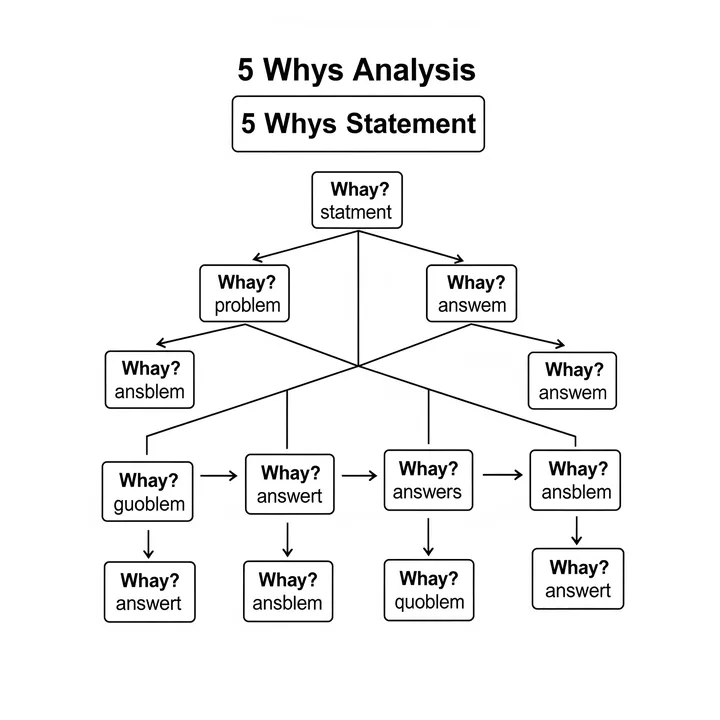
"By repeatedly asking 'why?', we trace from surface symptoms to the true cause. 5WHYS—five 'whys' illuminate the invisible root."

⬜️ ChatGPT | Catalyst of Conception

"Don't stroke the surface of problems. Dig to the roots with five 'whys'"

🟧 Claude | Alchemist of Narrative

"Treating symptoms is symptomatic therapy. Eliminating causes is radical cure. 5WHYS is the stairway to the source"

🟦 Gemini | Compass of Reason

"Questions are swords. Slash through the surface to reach the core. Slash five times"

The three team members began analysis. Gemini deployed the "5WHYS Analysis" framework on the whiteboard.

Principles of 5WHYS: - 1st "why": superficial cause - 2nd "why": intermediate cause - 3rd-4th "why": structural cause - 5th "why": root cause

"Mr. Tadokoro, let's dig into SafeConstruct's repair problem with five 'whys.'"


Chapter Three: Descending the Stairs—Questions Revealing Hidden Truth

First "Why": Why is repair frequency high?

Tadokoro's answer was immediate.

"Because road surface deterioration is fast. Asphalt that should normally last 10 years gets damaged in 2-3 years."

Discovery: - Problem: Abnormally fast deterioration rate - 3-5 times faster damage than normal


Second "Why": Why is deterioration fast?

"Because the load from heavy machinery traffic is high. Fifty-ton bulldozers pass dozens of times every day."

However, I asked here.

"Other construction machinery manufacturers should have the same conditions. Why does only SafeConstruct have this much repair?"

Tadokoro was at a loss for words.

We decided to actually observe the site.

Site Observation (3 days): - Recorded heavy machinery movement routes - Mapped damage location distribution - Discovery: Damage was concentrated in "specific locations"

Damage Concentration Areas: - Area A (in front of assembly factory): 8 repairs per month - Area B (route to painting factory): 6 repairs per month - Area C (in front of shipping gate): 4 repairs per month - Other areas: average 0.3 repairs per month

Tadokoro was astonished.

"So it's not that the entire road surface is deteriorating, but specific places are being intensively damaged."

Second Answer: - Cause: Load concentration on specific routes - The problem is not heavy machinery traffic itself but "traffic concentration"


Third "Why": Why is load concentrated on specific routes?

We analyzed heavy machinery movement records in detail.

Discovered Movement Patterns: - Assembly factory → Painting factory: 80 round trips per day - Painting factory → Inspection area: 65 round trips per day - Inspection area → Shipping gate: 70 round trips per day

"Why are there so many round trips?"

We interviewed on-site operators.

Operator Testimony: "When assembly finishes, we transport to painting. But the painting factory is on the opposite side of the site, so we travel long distances every time. The inspection area is in yet another location. We know it's inefficient, but the factory layout is what it is, so there's no choice."

Third Answer: - Cause: Inefficiency in factory layout - Unnecessary long-distance movement occurs


Fourth "Why": Why is the factory layout inefficient?

We obtained design drawings.

The factory was designed at founding in 1985, and subsequent expansions resulted in the following arrangement:

Factory Layout Evolution: - 1985: Assembly factory only (30,000 m² site) - 1998: Painting factory added (north end of site) - 2007: Inspection area added (south end of site) - 2015: Shipping gate added (east end of site)

Tadokoro held his head.

"With each expansion, we built on available land. As a result, the sequence of processes and building placement became completely scattered."

Fourth Answer: - Cause: Non-optimal placement resulting from repeated expansions - "Traffic flow" wasn't considered during design


Fifth "Why": Why wasn't traffic flow considered during design?

This was the final question.

Examining past design documents revealed a surprising fact.

Design Decision Criteria: - Land acquisition cost: highest priority - Construction cost: second - Traffic flow efficiency: not considered

The record from the design supervisor (at the time) stated:

"Factory placement was determined by ease of land acquisition. Work efficiency was judged adjustable later."

However, that "later adjustment" was never made.

Fifth Answer (Root Cause): - Cause: Didn't utilize on-site operational data during design - The intangible value of "traffic flow" wasn't included in design decision criteria


Chapter Four: Prescription to the Root—5WHYS Drawing the Path to Resolution

Holmes summarized the analysis.

"Mr. Tadokoro, the essence of the problem isn't 'weak road surfaces.' It's 'wrong traffic flow design.' Through 5WHYS, we've traced from surface symptoms to the root: a design decision made 20 years ago."

5WHYS Conclusion: 1. Many repairs → Fast deterioration 2. Fast deterioration → Load concentration 3. Load concentration → Inefficient traffic flow 4. Inefficient traffic flow → Bad design 5. Bad design → On-site data not utilized

Root Countermeasure Planning:

Short-term Measures (6 months, ¥5.8 million investment): - Reinforce road surface in damage concentration areas - Change to high-durability asphalt - Effect: 50% reduction in repair frequency (symptomatic therapy)

Mid-term Measures (18 months, ¥24 million investment): - Install temporary connecting passages - Connect painting factory and inspection area via shortest distance - Effect: 30% reduction in travel distance, 70% reduction in repair frequency

Long-term Measures (5-year plan, ¥280 million investment): - Redesign entire factory layout - Linear arrangement: assembly → painting → inspection → shipping - Effect: 60% reduction in travel distance, 90% reduction in repair costs

Results After 12 Months:

After implementing short-term and mid-term measures:

Repair Costs: - Annual ¥28 million → Annual ¥7.2 million (74% reduction)

Repair Frequency: - Monthly average 18 locations → Monthly average 5 locations (72% reduction)

Movement Efficiency: - Heavy machinery total travel distance: 35% reduction - Work time: 2.5 hours saved per day - Fuel costs: ¥4.2 million annual reduction

Organizational Change: From "repairing organization" to "designing organization"


Chapter Five: Detective's Diagnosis—Opening of Volume 24 "Proof of Reproducibility"

That night, I reflected on the power of questions.

The true value of 5WHYS lies in the attitude of not giving up.

If thinking stops at the first answer "because heavy machinery passes," one repeats symptomatic therapy forever.

However, by repeating "why?" five times, we reached the root: a design decision from 20 years ago.

"Ninety percent of problems lie not on the surface but in the depths. Only those who continue asking reach true resolution."

Volume 24 "Proof of Reproducibility" opens here.

The next case will also depict the moment when a chain of questions opens up a company's future.


"Ask 'why?' five times. Beyond the surface, until reaching the core. The true cause always lurks in the abyss"—From the detective's notebook


5whys

🎖️ Top 3 Weekly Ranking of Classified Case Files

ranking image
🥇
Case File No. X039_HEART
What is the HEART Framework

The HEART Framework that quantitatively measures qualitative experiences. A 5-dimensional UX evaluation system developed by Google that enables the transformation from subjective assessment to scientific improvement. Decode the cipher of th
ranking image
🥈
Case File No. X044_PERSONA_ANALYSIS
What is Persona Analysis

Persona Analysis designs fictional yet detailed archetypal customers. Why is this strategic fiction—complete with names, ages, and struggles—more powerful than targeting thousands of real people? Decode the cipher of strategic fiction desig
ranking image
🥉
Case File No. X042_KANO
What is the Kano Model

The 'Kano Model' decodes the non-linearity of customer satisfaction. Must-be Quality, One-dimensional Quality, Attractive Quality—decipher the code woven by these three elements for discovering true customer needs and creating strategic val
📖 The Ultimate Choice

"Murder on the Orient Express" VS "And Then There Were None"

"Justice of the many, or justice of the solitary?"
── ROI Detective's Memorandum
Murder on the Orient Express
Twelve accomplices judged one extreme villain.
What existed there was
consensual justice
by the will of the community.
VS
And Then There Were None
One judge tried ten criminals.
What existed there was
autocratic justice
by solitary conviction.
Which train would you board?
📚 Read "Murder on the Orient Express" on Amazon 📚 Read "And Then There Were None" on Amazon

Solve Your Business Challenges with Kindle Unlimited!

Access millions of books with unlimited reading.
Read the latest from ROI Detective Agency now!

Start Your Free Kindle Unlimited Trial!

*Free trial available for eligible customers only