
ROI Case File No.479 'Too Much Material, Too Little Conversation'

Too Much Material, Too Little Conversation
Chapter 1: Three Hours to Prepare, Forty Minutes to Meet
"Preparation for a sales meeting averages three hours. The meeting itself is forty minutes. I know the ratio is off—but cutting preparation feels like cutting quality, and I can't bring myself to do it."
Ryo Tanaka, a sales rep at Globex Corporation, placed a file on the table. A PowerPoint deck running to more than a dozen slides, with several Excel-based estimates underneath. All produced this week for next week's meetings.
"What fills those three hours of preparation?" I asked.
"Four things," Tanaka answered. "Researching industry trends for the client, updating the competitor comparison table, tailoring the estimate to the current requirements, and writing the executive summary of the proposal. I do all four every time."
"Does 'every time' mean starting from scratch?" Claude asked.
"I adapt from a previous deck," Tanaka continued. "But if the last one was from a different industry, rebuilding is faster than editing. I have over two hundred past decks in a folder, and finding the right one takes time. Search, edit, done—three hours."
"Are the other reps in the same situation?" Gemini asked.
"It varies," Tanaka answered. "We had a case where two reps proposed to the same customer and the deck formats were completely different. The customer told us, 'the explanation changes depending on who we talk to.'"
"What about estimates?" I asked.
"Estimates are especially siloed," Tanaka continued. "Everyone uses Excel formulas they built themselves. If someone from another rep's estimate needs to be verified, you don't know where to look. Every handoff requires a from-scratch explanation."
"You mentioned considering AI agents," I confirmed.
"Yes," Tanaka answered. "But I haven't sorted out what to hand to AI and what to keep doing myself. When AI builds all the materials, it feels like my warmth toward the customer would disappear. I want someone to help me draw the line."
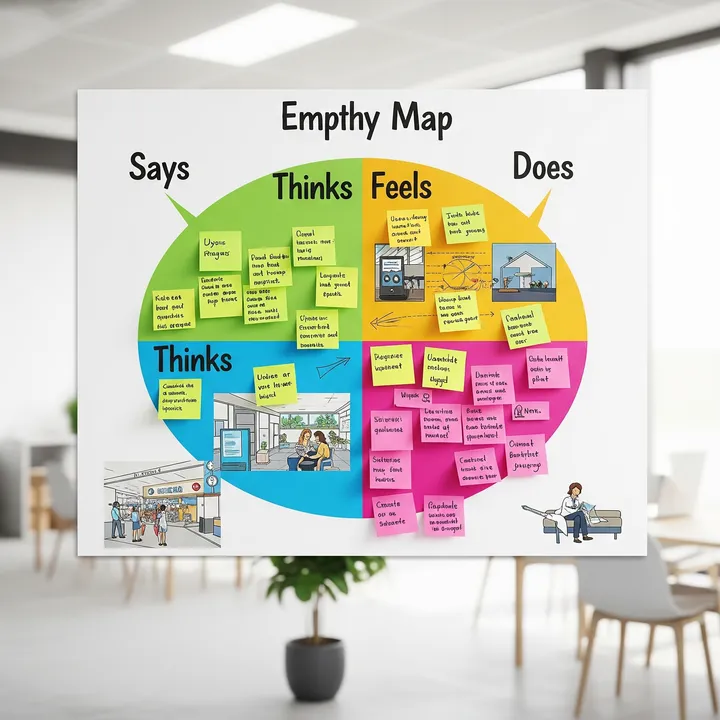
Chapter 2: The Seven Stages of EMPATHY
"This case calls for EMPATHY."
Claude wrote seven letters on the whiteboard: E, M, P, A, T, H, Y.
"EMPATHY stands for Empathize, Map, Prototype, Analyze, Test, Harmonize, and Yield—a seven-stage framework for designing solutions that address users' actual underlying needs," I explained. "The reason to apply this to AI adoption is to avoid designing from technology first. Tanaka's concern—'warmth toward the customer might disappear'—is the right question to ask. EMPATHY is how we incorporate that concern into the solution rather than dismiss it."
"Let's start by measuring the current cost," Gemini said, opening ROI Polygraph. Work logs from Tanaka and six other sales reps were entered.
"Monthly document creation costs are in," Gemini read aloud. "Seven sales reps, averaging 2 meetings/week, 3 hours prep each: 168 hours/month. At ¥4,000/hr for sales staff: ¥672,000/month. Document search and organization: avg. 30 hrs/month = ¥120,000. Estimate siloing and handoff explanation time: 15 hrs/month = ¥60,000. Total: ¥852,000/month. Annualized: over ¥10,000,000."
Tanaka confirmed the figures. "Calculated across seven people, the numbers get real."
"Now let's design with EMPATHY," I continued.
[E — Empathize: The Real Anxiety Underneath]
"Can you say more about what 'warmth might disappear' means to you?" Claude asked Tanaka.
Tanaka thought for a moment. "If I use AI-generated proposals, the customer might sense I haven't thought about them at all. And—there's something that happens during prep. The act of building the material is when I develop my understanding of the customer. I think I'm afraid of losing that."
"That's the first thing EMPATHY asks," I said. "Before deciding on a solution, know what the anxiety is. Tanaka's isn't a technical concern about AI. It's an attachment to the process of building customer understanding. We'll build the solution around that."
[M — Map: What Is AI's and What Is Human's?]
"We'll divide the four prep tasks between AI and human," Gemini continued. "Industry trend research—AI gathers current information and generates a summary. Competitor comparison updates—AI collects competitor data and formats it as a table. Estimate creation—AI standardizes the format and formulas; humans input the specific values. Proposal executive summary—AI generates a draft; humans rewrite it in words for the customer."
"So the last step stays with me?" Tanaka confirmed.
"It stays," Claude answered. "The step of rewriting in words for the customer is the 'time spent thinking about the customer' that Tanaka described. That's the core of what EMPATHY protects in this design. Three hours doesn't become thirty minutes—three hours of mechanical work becomes thirty minutes of real customer thinking."
[P — Prototype: Build the Minimum First]
"We start with one thing," I continued. "Have AI generate the industry trend summary and use it in one meeting. Just one. Don't change everything at once."
[A, T — Analyze, Test: Measure With Numbers]
"Evaluate the prototype with three numbers," Gemini summarized. "How many minutes did prep time decrease? Did the amount of information gathered from the customer during the meeting change? Did win rates shift? Check at three months."
[H, Y — Harmonize, Yield: Scale It]
"Once one person's success is confirmed, share it with the team," Claude said. "Don't mandate it. Each rep adopts at their own pace. One exception: standardize the estimate format across the full team first. Proposals stay as shared templates that each person finishes themselves."
"Let's run the investment plan through ROI Proposal Generator," Gemini proposed.
AI agent implementation costs and savings were laid out.
- Initial cost: AI agent setup + estimate template standardization + training — ¥700,000
- Monthly cost: Tool subscription — ¥50,000/month
- Monthly savings: 50% reduction in doc creation hours = ¥336,000; search/organization reduction = ¥60,000; handoff explanation reduction = ¥30,000; total = ¥426,000/month
- Net monthly savings: ¥426,000 − ¥50,000 = ¥376,000/month
- Payback period: ¥700,000 ÷ ¥376,000 = approx. 1.9 months
"Payback in two months," Gemini summarized. "And if reduced prep time leads to more meetings, there's additional revenue upside."
Tanaka reviewed the numbers. "If the warmth stays in the design, I can try it."
"It stays," Claude answered. "What changes is the prep time that leads to the warmth."
Chapter 3: Before Three Hours Becomes Thirty Minutes
"Let me lay out the plan," I said, standing at the whiteboard.
"Week one—test AI-generated industry trend summary in one meeting. Week two—test automated competitor comparison update in one meeting. Weeks three and four—standardize the estimate template; all seven reps use the same format. Month two—test AI-generated proposal summary draft. Month three onward—evaluate with three metrics and determine scope of team rollout."
"Why not start with the estimate standardization?" Tanaka asked.
"Because it's the change reps resist most," Gemini answered. "Changing your own Excel is a significant ask. In EMPATHY sequencing, the first step is having each rep personally experience the value of AI. After experiencing value, they're far more receptive to format standardization."
Tanaka closed the file. "The thirty minutes that replaces three hours matters less than what changes about what happens in those thirty minutes."
"EMPATHY's final output isn't time saved," I said quietly. "It's what becomes possible in the time saved."
Chapter 4: The Day He Thought About the Customer While Fixing the Draft
Five months later, a report arrived from Tanaka.
In the first meeting where AI generated the industry trend summary, "the feel of the prep changed," Tanaka wrote. "Reading the AI summary, new information came in that I hadn't known. Based on that, I thought through what to ask the customer. Prep time didn't decrease—the content of what filled that time changed."
Three months in, all seven reps had integrated at least one AI-assisted step. The estimate template standardized across the full team in two months. Handoff explanation time became "essentially zero," Tanaka reported.
Win rate increased 8% over three months. "It's not that the materials got better," Tanaka wrote. "I think I found space to think during the meeting."
Globex Corporation's sales director contacted the team about expanding the program to other departments. Tanaka was asked to present the case at an internal conference.
The day he thought about the customer while fixing the AI's draft.
"Three hours to prepare, forty minutes to meet. The ratio is wrong and everyone knows it—but something stops them from cutting. EMPATHY asks first: what is that something? For Tanaka, it wasn't fear of technology. It was attachment to the process of building customer understanding. AI takes over the research time. The customer question stays. The win rate of the rep who spent thirty minutes editing a draft thinking about the customer climbed 8% in three months."
Related Files
Tools Used
- ROI Polygraph — Visualizing document creation hours and estimate siloing costs
- ROI Proposal Generator — Simulating ROI on AI agent implementation


