
ROI Case File No.579 'We Were Searching for the Reason It Went Unused Only on the Inside'

We were searching for the reason it went unused only on the inside
Chapter 1: It goes unused—but the reason is unclear
"We want the internal portal we built on SharePoint to be used more."
Nozomi Mikumo, the portal manager at TechNova, described the situation. "We launched it grandly two years ago. But employees hardly use it. Everyone shares information on Teams. At my previous job I used Google Workspace, my knowledge of SharePoint is thin, and I'm cornered."
"How are you searching for the reason it goes unused?" Claude asked.
"By reviewing the inside of our own portal," Mikumo answered. "Where is it hard to use, is the arrangement of information bad. I tinker with the internal settings this way and that. But I can't grasp why it goes unused."
"Have you looked at the voices of the employees who use it, or at other companies' portals?" I confirmed.
"…I haven't," Mikumo answered. "I've been searching only within the company. What the using employees are troubled by, how other companies build theirs. I've never looked from the outside."
"Search for the reason it goes unused only on the inside, and you won't grasp it," I replied. "Let's break it down with the 3Cs."
Chapter 2: What the 3Cs ask—look from three sides: customer, competitor, company
"This case calls for the 3Cs."
Claude wrote on the whiteboard: "Customer, Competitor, Company."
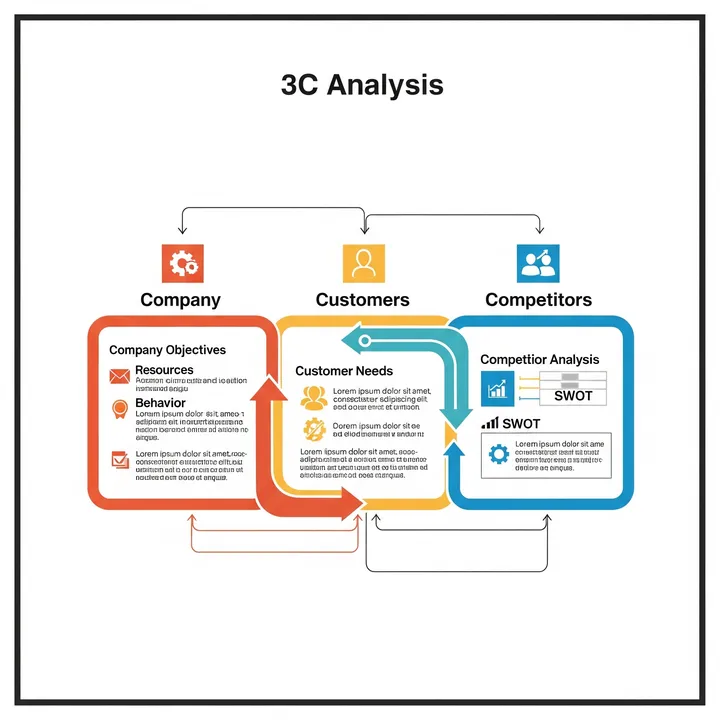
"The 3Cs—the three perspectives of customer, competitor, and company—is a framework that looks at a problem from three sides to pin down the cause and the move," I explained. "The crux is not searching only within the company. The reason it goes unused becomes clear only when you look at the voices of the using employees (customer) and the builds of other companies (competitor). Because you cross-check the three sides, the cause that wasn't visible from the inside surfaces. It's a tool for looking from the outside."
"First, let's measure the current cost," Gemini said, opening ROI Polygraph. He entered the data Mikumo had provided.
"The monthly cost is out," Gemini read off. "Search labor from the portal going unused because information can't be found averages 160 hours a month; at ¥3,700 an hour, that's ¥592,000 a month. Duplication and scatter of information from also using Teams average ¥400,000 a month. The wasted introduction investment from the portal not being utilized averages ¥360,000 a month. Delayed arrival at needed information from information overload averages ¥340,000 a month. Update stalls from person-dependent operation average ¥300,000 a month. The total is ¥1,992,000 a month—about ¥23.9 million a year."
Mikumo stared at the figures. "I'd been watching only the fact that it goes unused. Once you add the duplication and the wasted investment, it comes to this much."
"Then let's design it with the 3Cs," I continued.
[Customer—hear the voices of the using employees]
"First, the customer," Claude said. "Survey the using employees and surface the causes for not using it. Confusing UI, scattered information, poor access to needed information. Not the inside's guesswork—grasp the cause from the voices of the people who use it."
[Competitor—look at other companies' portals]
"Next, the competitor," Gemini continued. "Study other companies' portals. Simple design, intuitive navigation, a dashboard that shows key information at a glance. What your own company lacks surfaces when you look outside."
[Company—review the role and how it's used]
"After the competitor, the company," I continued. "Re-evaluate the current portal's role and how it's used. Information is overloaded and unorganized, and employees struggle to search. On the basis of customer and competitor, grasp your own weaknesses precisely."
[Integration—cross-check the three sides and produce the move]
"Last, integration," Claude continued. "Cross-check the readings from the three sides. Make the UI simple, show at a glance with a dashboard, improve continuously through feedback. Because you lined up all three, the move that wasn't visible from the inside emerges."
[Estimating the payback]
"Let's run the numbers with the ROI Proposal Generator," Gemini proposed.
- Initial cost: three-sided analysis (employee survey, competitor study, company assessment), UI renewal, dashboard build, information organization, and continuous-improvement design—¥4.8 million total
- Monthly cost: portal operation plus ongoing maintenance—¥200,000
- Monthly savings: efficiency of information searching = ¥420,000 (assuming a 70% reduction); resolution of information scatter = ¥340,000; investment recovery through portal utilization = ¥280,000; resolution of delayed arrival = ¥280,000; ¥1,320,000 a month total
- Net monthly savings: ¥1,320,000 − ¥200,000 = ¥1,120,000 a month
- Payback period: ¥4.8 million ÷ ¥1,120,000 = about 4.3 months
"A little over four months to recover," Gemini summarized. "What works is not searching only within the company but looking from three sides. Merely tinker with the inside and you can't grasp the cause of it going unused. Because you look at the customer's voice and the competitor's build, both cause and move surface. The investment doesn't swing at empty air."
Mikumo said as she checked the numbers. "I thought reviewing the inside of our own company would settle it. Unless you look at the customer and the competitor, you can't grasp the cause."
"The 3Cs are a tool for looking from three sides: customer, competitor, and company," I replied.
Chapter 3: An implementation plan that looks from three sides
"Let me lay out the approach," I said, standing before the whiteboard.
"Month one—customer analysis through an employee survey and a study of competitor portals. Month two—re-evaluate the role and usage of the company's own portal and cross-check the three sides. Months three and four—renew the UI and build the dashboard. Month five—organize the information and systematize feedback collection. Month six—trial run and effect verification. Month seven onward—continuous improvement and expansion of the utilization scope."
"If we fix our own portal, it'll get used—right?" Mikumo confirmed.
"Fixing the inside alone isn't enough," Claude replied. "You can't grasp the cause of it going unused without looking at the voices of the using employees and other companies' builds. Fix it on inside guesswork and you miss the mark. Cross-check the three sides with the 3Cs, and the cause surfaces and the move hits the mark. Looking from the outside comes before tinkering with the inside."
Mikumo said as she took notes. "Before reviewing the inside, look from three sides. I can see the order now."
Chapter 4: The day, looking from three sides, it began to be used
Ten months later, a report arrived from Mikumo.
The portal came to be used after the three-sided analysis. "The confusing UI became simple. Employees began to access it naturally," Mikumo wrote.
The information scatter cleared too. The dashboard showed key information at a glance. "The information sharing that had escaped to Teams came back to the portal. Duplication decreased," the report said.
The biggest change showed in how the cause was searched for. From searching only within the company, they shifted to looking from three sides. "I'd been doing nothing but tinkering with settings. Once I looked at the using employees' voices and other companies' builds, why it went unused came into view all at once," Mikumo wrote.
Arrival became faster too. Organizing the information untangled the delay in reaching needed information. "What couldn't be found because of information overload could now reach the target quickly," the report said.
As a side effect, the way improvement was viewed changed. Rather than only the inside, the habit of looking from three sides took root. "I stopped ending at 'review our own company.' I began to think from the three sides of customer, competitor, and company," Mikumo wrote.
At the end of Mikumo's report was written: "I thought the portal trouble was the poorness of our own build. But the real problem was that I was searching for the reason it went unused only on the inside. The moment I looked from three sides with the 3Cs, both cause and move came into view. Before reviewing the inside, looking from three sides came first."
On the day a company that had searched for the reason it went unused only on the inside became a company that could improve by looking from three sides, the portal improvement had changed from a review of the company's own inside into a design that looks from three sides—customer, competitor, and company.
"A consultation about portal improvement usually arrives in the form of 'we want to fix our own build.' But before tinkering with the inside, there's something to ask. Are you looking at the users and other companies? What the 3Cs ask is the three of customer, competitor, and company. Cross-check the three sides and the cause that wasn't visible from the inside surfaces. On the day a company that had searched for the reason it went unused only on the inside could look from three sides, what changed was not the portal's build but the very perspective of looking from three sides—customer, competitor, and company."
Related Files
Tools Used
- ROI Polygraph — visualizing information-search labor, information duplication, and the wasted introduction investment
- ROI Proposal Generator — a payback simulation for internal-portal improvement, starting from a three-sided analysis of customer, competitor, and company


