
ROI Case File No.546: Before Saying 'Use It,' No One Had Made Anyone Want To

Before Saying "Use It," No One Had Made Anyone Want To
Chapter 1: The Tax Accountant Is Leaving and Accounting Will Stop Running
"By the parent company's policy, our contract with the tax accountant is ending. All the accounting work comes in-house. We want to make it efficient with AI."
Seiichi Aida, head of accounting at GlobalTech Solutions, said this with impatience showing through. "The work we'd left to the tax accountant comes down wholesale into the company. When I run the estimate, it'll produce over forty hours of overtime a month."
"What state is your current accounting work in?" Claude asked.
"There's a lot of paper," Aida answered. "Digitalization hasn't advanced. We have to do both cost reduction and efficiency, or it won't run. I also want to hold down the roughly ¥170,000 per month in costs. Down the line I want an AI agent to do financial and management accounting, but efficiency before then is urgent."
"Suppose you introduce an AI tool—does it seem the floor will use it?" I confirmed.
"That's the worry," Aida answered. "Accounting is highly specialized, and there's resistance to new tools. Even if we say 'use it' and hand it out, I feel they'll end up back on the old handwork. 'Introduced but not used' is what scares me most."
"Before saying 'use it,' you need a sequence that makes them want to," I responded. "Let's design with AIDMA."
Chapter 2: What AIDMA Asks—The Sequence From Interest to Action
"This case needs AIDMA."
Claude wrote "A, I, D, M, A" on the whiteboard.
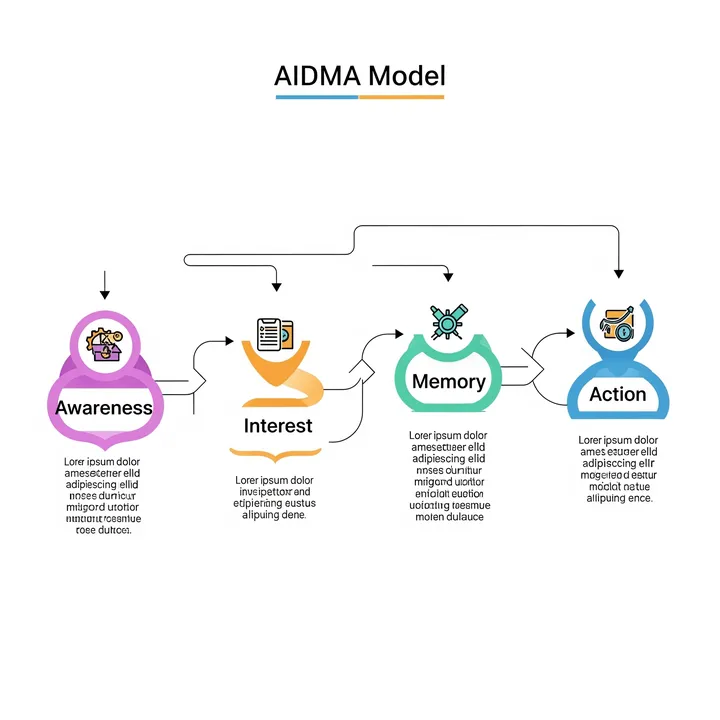
"AIDMA is a framework taking the initials of Attention, Interest, Desire, Memory, and Action—it expresses the stages a person passes through before reaching action," I explained. "It's originally a theory of consumer purchasing behavior, but it works for embedding a tool internally too. The slogan 'use it' demands Action all at once. Draw attention, spark interest, make them want to use it, lodge the procedure in memory, then lead them to action. It's a tool that solves tool adoption that fails to stick, through sequence."
"First, let's measure the current cost," Gemini said, opening the ROI Polygraph. He entered the data Aida had provided.
"The monthly cost is in," Gemini read out. "Increased labor for in-house accounting tied to the tax-accountant contract ending: 150 hours per month on average, at ¥4,200 per hour, ¥630,000 per month. Handwork labor from paper-document processing and digitalization delay: ¥380,000 per month on average. Outsourcing and tool-overlap cost: ¥170,000 per month on average. Rework from accounting-processing mistakes and send-backs: ¥250,000 per month on average. Opportunity loss from stalled adoption due to a lack of internal AI know-how: ¥300,000 per month on average. A total of ¥1,730,000 per month. Annualized, about ¥20,760,000."
Aida stared at the figures. "I thought it was just overtime hours. Add the paper handwork and the cost of stalling unused, and it's this much?"
"Now, let's design with AIDMA," I continued.
[Attention—Make Them Aware of AI Use]
"First, we draw the company's attention," Claude said. "We show the merits of AI adoption and success cases in a seminar. Before 'use it,' we make them aware of why it's needed. Where there's no attention, no action is born."
[Interest—Spark Interest in a Concrete Tool]
"Next, we spark interest," Gemini continued. "We demo a tool that digitalizes paper documents and automates accounting. Not abstract theory—show them how their own work gets easier, and interest moves."
[Desire and Memory—Make Them Want To and Leave the Procedure]
"We turn interest into desire and lodge the procedure in memory," I continued. "We show how their own problems get solved to draw out the 'I want to use it,' and hand out materials on functions and procedures to simulate operation. So they don't get lost when it's time to use it, we create memory."
[Action—Move to Action With a Pilot Run]
"Finally, action," Claude continued. "We start a pilot run in the accounting department. After they feel the effect, we widen it company-wide. Because we have them act after passing through the sequence, it doesn't end at handing it out."
[Calculating the Investment Recovery]
"Let's run the estimate with the ROI Proposal Generator," Gemini proposed.
- Initial cost: AI seminar, tool selection and demo, paper-document digitalization infrastructure, accounting-automation adoption, pilot run, and training—¥3,700,000 total
- Monthly cost: Tool usage fee and operation ongoing fees combined, ¥160,000 per month
- Monthly reduction effect: Accounting labor and overtime reduction = ¥500,000 per month (assuming 80% reduction), reduction from paper-document digitalization = ¥300,000 per month, resolution of outsourcing cost and overlap = ¥150,000 per month, rework reduction = ¥180,000 per month, totaling ¥1,130,000 per month
- Net monthly reduction: ¥1,130,000 − ¥160,000 = ¥970,000 per month
- Payback period: ¥3,700,000 ÷ ¥970,000 = approximately 3.8 months
"Recovery in just under four months," Gemini summarized. "What works is following the sequence rather than distributing company-wide at once. We build attention, interest, desire, and memory, then move to action with an accounting-department pilot. Because we make them want to use it before handing it out, we avoid the failure of 'introduced but not used.'"
Aida confirmed the figures. "We were just handing it out saying 'use it.' Follow the sequence, and the floor comes to want to use it on its own. That's what was missing."
"AIDMA is a tool that makes people want to use it before the slogan," I responded.
Chapter 3: A Deployment Plan That Makes Them Want To Before Handing It Out
"Let me organize the approach," I said, standing at the whiteboard.
"Month one—holding the AI-use seminar, arousing attention. Month two—tool selection and demo, arousing interest. Month three—presenting the problem-solution picture and distributing procedure materials, forming desire and memory. Month four—pilot run in the accounting department, beginning action. Month five—effect verification and operational improvement. Month six onward—company-wide rollout, development into financial and management accounting via an AI agent."
"Will it make it in time before the tax accountant leaves?" Aida confirmed.
"Because we follow the sequence, it's actually faster," Claude responded. "Hand it out without making them want to use it, and reversion happens and it ends up redone. Build from attention to memory and enter the pilot, and the floor uses it on its own. With no redo, it makes it in time for when the tax accountant leaves."
Aida said, taking notes, "I never had the idea that there are four stages before action. Make them want it before handing it out, and they don't revert."
Chapter 4: The Day Accounting Began Running In-House
Nine months later, a report arrived from Aida.
The feared overtime was greatly held down by the AI tool taking hold. "Overtime that was projected to exceed forty hours a month settled under ten. Even with the tax accountant gone, accounting began running in-house," Aida wrote.
Paper handwork also dropped sharply. With digitalization advanced, processing grew faster. "The work of finding paper and entering it by hand vanished. We learned that even with highly specialized accounting, it can be made efficient," the report read.
The biggest change appeared in how the tool was used. Unlike the past, where it ended at handing it out, it took hold. "Rather than 'use it,' we made them want to use it before handing it out. This time, no one reverted to the old handwork," Aida wrote.
External costs were reduced too. The ¥170,000-per-month cost was compressed. "What we paid externally decreased. Cost reduction and efficiency both stood up," the report read.
As a secondary effect, resistance to AI thinned. Because they followed the sequence, the highly specialized accounting members accepted AI. "The more specialized, the more cautious about new things—but introduce it after making them aware, and they came to use it on their own," Aida wrote.
At the end of Aida's report it said: "I thought a tool gets used if you hand it out. But the real problem was the absence of a sequence that makes people want to use it. The moment we designed from attention to action with AIDMA, the floor moved on its own. Before the slogan, a sequence is needed."
The day a company that had made no one want to use it before saying 'use it' became a company that could make them want to before handing it out, operational efficiency had changed from a slogan that ends at handing out into a sequence that leads from interest to action, the report noted.
"AI-adoption consultations are usually shadowed by the worry of 'will it be used.' Hand out the tool and the floor reverts to old handwork—'introduced but not used' is the most common failure. What AIDMA asks is the sequence of attention, interest, desire, memory, action. 'Use it' demands action all at once. Make them aware, spark interest, make them want to, leave the procedure, then have them act. The day a company that hadn't made anyone want to use it could follow the sequence, what changed was not the AI tool but the very perspective that makes people want to use it before the slogan."
Related Files
Tools Used
- ROI Polygraph — Visualizing increased accounting labor, paper-document handwork, and stalled-adoption cost
- ROI Proposal Generator — Investment-recovery simulation for internal adoption that leads from interest to action


