
ROI Case File No.549: Making the Document Had, Before Anyone Knew It, Become the Job

Making the Document Had, Before Anyone Knew It, Become the Job
Chapter 1: Time Vanishes Into Making Excel Documents
"Creating Excel documents for accounting takes too much time. We want to make it efficient with AI."
Tatsuya Masuda, head of accounting at Globex Corporation, said this as he described the situation. "We use multiple systems, and each has its own separate master management. We cross-reference the data and make documents in Excel. Enormous time vanishes into this work every month."
"What else hinders the efficiency?" Claude asked.
"The manuals are old," Masuda answered. "They were made five to ten years ago and haven't been updated. There's a lot of analog work too, and we have no one in the company who knows AI well. There's no one who can judge which work to use AI on."
"What are those documents made for?" I confirmed.
"...Now that you ask," Masuda answered. "I feel making the document itself has become the end before we knew it. We really just want to assemble the data used for management decisions, yet our time is taken up arranging Excel."
"You need to recapture this from the job you originally want done, not from the work's procedure," I responded. "Let's break this down with JTBD."
Chapter 2: What JTBD Asks—The Job You Really Want Done
"This case needs JTBD."
Claude wrote "JTBD" on the whiteboard.
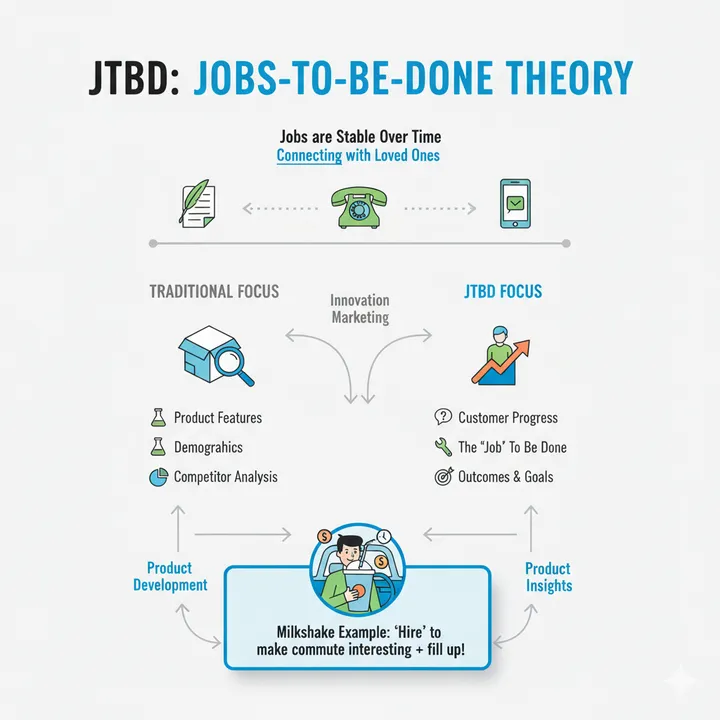
"JTBD—Jobs To Be Done—is a framework that recaptures work or a product from the goal a person truly wants to achieve," I explained. "The crux is not mistaking the means for the end. Making the Excel document is the means; the real job is 'to assemble data usable for decisions.' Let the means become the end, and time vanishes into making the document itself. It's a tool that redefines work as the job to be done and finds the means AI can replace."
"First, let's measure the current cost," Gemini said, opening the ROI Polygraph. He entered the data Masuda had provided.
"The monthly cost is in," Gemini read out. "Handwork labor for Excel-document creation: 190 hours per month on average, at ¥4,200 per hour, ¥798,000 per month. Cross-checking and double-management labor from fragmented master management across multiple systems: ¥500,000 per month on average. Rework and inquiries from manuals not updated in five-to-ten years: ¥350,000 per month on average. Opportunity loss from stalled measures due to an inability to judge AI use: ¥380,000 per month on average. Expected value of document-creation personnel-dependency risk: ¥330,000 per month on average. A total of ¥2,358,000 per month. Annualized, about ¥28,300,000."
Masuda stared at the figures. "I thought it was just the time to make Excel. Add the master cross-checking, and the cost of not being able to judge in the first place, and it's this much?"
"Now, let's design with JTBD," I continued.
[Redefining the Job—Find the Real Task]
"First, we recapture the work as the job to be done," Claude said. "Not 'make the Excel document' but 'assemble data usable for decisions' is the real job. Seen by the job rather than the means, much of the work arranging Excel turns out not to connect directly to the job."
[Mapping the Procedure—Trace the Steps the Job Needs]
"Next, we trace the steps to fulfill the job," Gemini continued. "Which steps of document creation are needed for the job, and which are waste born of the means' convenience? Map the steps, and the points AI can replace become visible."
[AI Replacement—Automate the Means]
"We hand the replaceable means to AI," I continued. "We cut Excel-creation time with data-entry automation, and dissolve the complexity of master cross-checking by automating inter-system data linkage. A sorting where people hold the job and AI carries the means."
[Manual Update—Leave the Job in the Procedure]
"Finally, we leave the procedure aligned with the job in the manuals," Claude continued. "We update the old manuals to the latest procedure that fulfills the job. A structure where, even when the means change, the job is succeeded."
[Calculating the Investment Recovery]
"Let's run the estimate with the ROI Proposal Generator," Gemini proposed.
- Initial cost: Business-job redefinition, data-entry automation tool adoption, inter-system data linkage, manual maintenance, and training—¥5,000,000 total
- Monthly cost: Tool usage fee and operation ongoing fees combined, ¥220,000 per month
- Monthly reduction effect: Automation of Excel-document creation = ¥620,000 per month (assuming 80% reduction), cross-checking labor reduction via master linkage = ¥400,000 per month, rework reduction via manual maintenance = ¥260,000 per month, resolution of stalled measures = ¥280,000 per month, totaling ¥1,560,000 per month
- Net monthly reduction: ¥1,560,000 − ¥220,000 = ¥1,340,000 per month
- Payback period: ¥5,000,000 ÷ ¥1,340,000 = approximately 3.7 months
"Recovery in just under four months," Gemini summarized. "What works is questioning the very job of making Excel, rather than making Excel faster. Work that doesn't connect directly to the job isn't needed in the first place. Because we recapture from the job to be done, we don't merely automate the means—we erase the wasteful means entirely."
Masuda confirmed the figures. "I only thought of making documents faster. Seen from the real job, there are documents that don't need to be made. The means had become the end."
"JTBD is a tool that questions the job itself, not the efficiency of the means," I responded.
Chapter 3: A Deployment Plan That Recaptures From the Job
"Let me organize the approach," I said, standing at the whiteboard.
"Month one—business hearing and job redefinition, pinpointing the real job. Month two—mapping the procedure, sorting out work that doesn't connect directly to the job. Months three and four—building data-entry automation and inter-system linkage. Month five—maintaining the manual aligned with the job. Month six—trial operation and effect verification. Month seven onward—expanding the AI-use scope, establishing a data foundation usable for decisions."
"But we have no one in the company who knows AI well," Masuda confirmed.
"Because we enter from the job, that's fine," Claude responded. "The reason you can't judge without knowing AI well is that you think from the means. Decide 'which job do we want done' first, and you simply choose the means that fits it. Because the job becomes the compass, even without AI know-how, where to use it gets decided."
Masuda said, taking notes, "Question the job itself, not the efficiency of the work. The order was reversed."
Chapter 4: The Day Document Creation Returned to the Job
Nine months later, a report arrived from Masuda.
Excel-document creation saw labor greatly reduced after the automation tool was adopted. "With data entry automated, the time arranging documents vanished. Work we'd done by hand assembles almost automatically," Masuda wrote.
The fragmentation of master management also headed toward resolution. With inter-system data linkage automated, the cross-checking chore decreased. "The work of cross-referencing separate masters went away. We were freed from double management," the report read.
The biggest change appeared in how work was grasped. From a state where making documents was itself the end, they could spend time on the job. "The time that vanished into arranging Excel returned to assembling data usable for decisions. We realized the means and the end had been reversed," Masuda wrote.
The old manuals were updated too. They were rewritten into the latest procedure aligned with the job. "Manuals left as they were five years ago became ones that mirror the current job," the report read.
As a secondary effect, they became able to judge AI use. The mindset of thinking from the job became the standard for where to use AI. "Even without knowing AI well, work backward from 'we want this job done' and where to use it gets decided," Masuda wrote.
At the end of Masuda's report it said: "I thought the accounting trouble was the effort of document creation. But the real problem was that making documents itself had become the end. The moment we recaptured from the job with JTBD, even the unneeded work became visible. Questioning the job came before the efficiency of the means."
The day a company where making documents had become the job became a company that could spend time on the job, operational efficiency had changed from the work of making the means faster into a design that re-questions the job to be done, the report noted.
"Operational-efficiency consultations usually come in the form of 'I want to make this work faster.' But before making it faster, there's something to ask. Does this work connect directly to the truly needed job? What JTBD asks is the job a person truly wants done. Making the Excel document is the means; the job is assembling data used for decisions. Let the means become the end, and time vanishes into making it. The day a company where making documents had become the job could return to the job, what changed was not the AI tool but the very perspective that re-questions the job rather than the means."
Related Files
Tools Used
- ROI Polygraph — Visualizing Excel-document-creation labor, master cross-checking labor, and stalled-measure cost
- ROI Proposal Generator — Investment-recovery simulation for operational efficiency rooted in the job to be done


