
ROI Case File No.571 'Weighing Only the Price, Blind to the Other Three'

Weighing only the price, blind to the other three
Chapter 1: We want to switch cheaply—but the deciding factor won't settle
"We'd like to move our workflow system over to another vendor's product. The trouble is, we can't tell which one to pick."
Hitoshi Kohda, information systems manager at Globex Corporation, explained the situation as he spoke. "Right now we've used two systems for a long time: the on-premises version of Cybozu Garoon, and AgileWorks, which is dedicated to approval routing. Garoon's support ends in two years. They're recommending we move to the cloud version, but the price is high. AgileWorks will eventually raise its price too. I'd like to consolidate ordinary workflow and approval routing into one cheaper system."
"When you choose, what are you using as your standard?" Claude asked.
"Price," Kohda answered. "I just want to hold costs down. So I line up each vendor's quote and look at them from cheapest to most expensive. But I've been uneasy about whether it's all right to decide on cheapness alone."
"Besides price, are you looking at usability, at the flow of approvals, at resilience to future change?" I confirmed.
"…I'm not," Kohda answered. "I've only been thinking about cost. Whether the people who use it will be satisfied, whether approvals will circulate smoothly, whether the organization can adapt when it changes. I've never put those on the scale."
"With a single scale—cheapness—you can't measure good from bad," I replied. "Let's break it down with the BSC."
Chapter 2: What the BSC asks—measure comprehensively across four perspectives
"This case calls for the BSC."
Claude wrote on the whiteboard: "Financial, Customer, Internal Process, Learning & Growth."
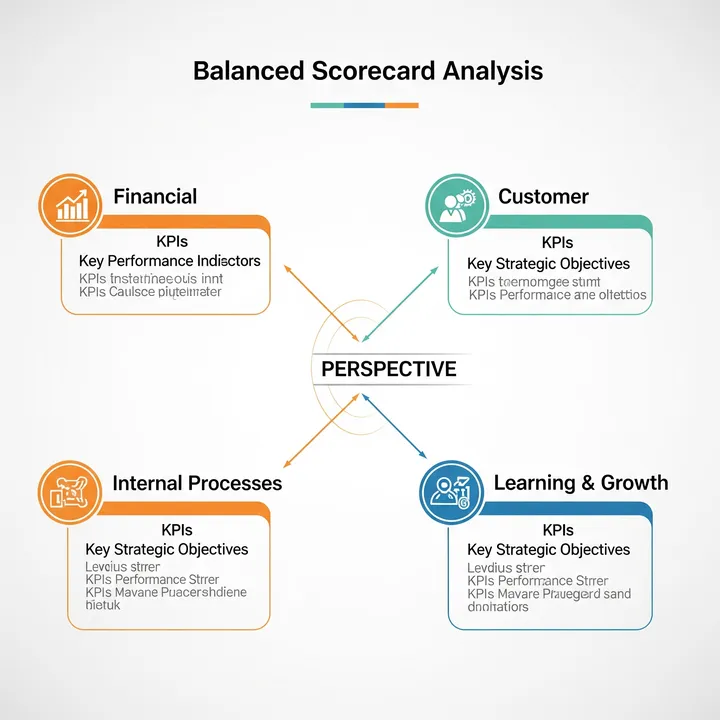
"The BSC—the Balanced Scorecard—is a framework that evaluates an initiative comprehensively from four perspectives: financial, customer, internal process, and learning & growth," I explained. "The crux is not measuring with only one scale. Finance certainly matters, but on its own it hands you a system so unusable that no one touches it. Customer satisfaction, process efficiency, resilience to change. Only when you put all four on the scale does the truly good choice come into view. It's a tool for removing bias."
"First, let's measure the current cost," Gemini said, opening ROI Polygraph. He entered the data Kohda had provided.
"The monthly cost is out," Gemini read off. "Information-systems labor from the dual operation and maintenance of two systems averages 150 hours a month; at ¥3,800 an hour, that's ¥570,000 a month. The excess-cost risk of taking the high cloud-version quote at face value averages ¥400,000 a month. The inefficiency of double logins and information searching from the lack of Microsoft 365 integration averages ¥340,000 a month. Approval stalls and send-backs from weak notifications and cumbersome approval steps average ¥360,000 a month. The maintenance-delay risk from person-dependent handling of organizational changes averages ¥320,000 a month. The total is ¥1,990,000 a month—about ¥23.88 million a year."
Kohda stared at the figures. "I'd been watching only the difference in price. Once you add usability, approval stalls, and the cost of dual operation, it comes to this much."
"Then let's design it with the BSC," I continued.
[The financial perspective—put cost on one scale]
"First, finance," Claude said. "Don't swallow the high cloud-version quote whole; compare other vendors' products where price band and features match. Hold down both migration cost and running cost. But this is only one of four. We don't decide here alone."
[The customer perspective—measure the satisfaction of the people who use it]
"Next, the customer," Gemini continued. "The users are the employees. Single sign-on with Microsoft 365 and the presence of external integrations change daily usability. Cheap but hard to use means it won't get used in the end. We put user satisfaction on the scale."
[The internal-process perspective—measure the flow of approvals]
"After the customer, the internal process," I continued. "Strengthen notifications and simplify approval steps. Build a flow where approvals don't stall and send-backs decrease. Untangle the complexity of operational management. We put onto the scale whether the process actually turns."
[The learning & growth perspective—measure resilience to change]
"Last, learning & growth," Claude continued. "Organizations change. Is it a product that can follow the addition or removal of departments and shifts in roles through configuration changes? Does it avoid person-dependence and withstand future growth? We put resilience to change on the scale."
[Estimating the payback]
"Let's run the numbers with the ROI Proposal Generator," Gemini proposed.
- Initial cost: Selection of the replacement, data migration, SSO/external-integration setup, approval-flow redesign, and operational transition—¥4.8 million total
- Monthly cost: New-system license plus ongoing operation—¥210,000
- Monthly savings: dual-operation elimination through consolidating two systems = ¥400,000 (assuming a 70% reduction); license-cost reduction through cloud optimization = ¥340,000; reduced information searching through SSO and external integration = ¥280,000; elimination of approval stalls through simplified approval flow = ¥300,000; ¥1,320,000 a month total
- Net monthly savings: ¥1,320,000 − ¥210,000 = ¥1,110,000 a month
- Payback period: ¥4.8 million ÷ ¥1,110,000 = about 4.3 months
"A little over four months to recover," Gemini summarized. "What works is not choosing on cheapness alone but measuring comprehensively across four perspectives. Decide on finance alone and you grab an unusable system that goes unused. Because you put it on all four scales, cost and satisfaction don't collapse afterward. The investment doesn't swing at empty air."
Kohda said as he checked the numbers. "I thought a cheap switch would settle it. Unless you measure with four, you end up buying cheap junk."
"The BSC is a tool for measuring across four perspectives without bias," I replied.
Chapter 3: An implementation plan that chooses on four scales
"Let me lay out the approach," I said, standing before the whiteboard.
"Month one—set the evaluation criteria for the four perspectives and take stock of the present state. Month two—select replacement candidates and compare them across the four perspectives. Months three and four—build the new system and migrate the data. Month five—configure SSO and external integrations and redesign the approval flow. Month six—trial run and effect verification. Month seven onward—embedding responsiveness to organizational change and continuous review across the four perspectives."
"In the end, if we pick the cheap system, costs go down—right?" Kohda confirmed.
"That's the pitfall," Claude replied. "Choose on finance alone, and hidden costs swell later—no one uses it because it's hard to use, approvals stall, it can't follow organizational change. Measure across four perspectives with the BSC, and cheapness, usability, and future-readiness stand together. Putting it on all four scales is, in the end, the cheapest path."
Kohda said as he took notes. "Before comparing prices, weigh across four perspectives. I can see the order now."
Chapter 4: The day we could choose, on four scales
Ten months later, a report arrived from Kohda.
Dual operation changed greatly after consolidation. "Maintaining Garoon and AgileWorks separately became one system. The hands tied up in double operation were freed," Kohda wrote.
Usability rose too. Single sign-on with Microsoft 365 erased the daily login friction. "We avoided settling for a cheap-only product. The employees who use it spoke up that it had become easier to use," the report said.
The biggest change showed in how they chose. From putting only cheapness on the scale, they shifted to measuring across four perspectives. "I'd been lining up nothing but price differences. Once I put it on all four scales, cost, satisfaction, process, and future-readiness came into a single view, and I could choose without hesitation," Kohda wrote.
The approval flow changed too. Stronger notifications and simplified approval steps untangled the stalls. "Send-backs and wait times fell. Approvals began to circulate without clogging," the report said.
As a side effect, the very way system selection was viewed changed. Rather than pouncing on cheapness, the habit of measuring on four took root. "I stopped scanning quotes from cheapest to most expensive. I began to think in terms of whether finance, customer, process, and growth were all lined up," Kohda wrote.
At the end of Kohda's report was written: "I thought switching workflow systems meant finding a cheap system. But the real problem was that I held only one scale—cost—and the other three were missing. The moment I put it on the four BSC perspectives, good and bad became measurable. Before comparing cheapness, weighing on four came first."
On the day a company that had weighed only cheapness while the other three were missing became a company that could choose across four perspectives, the system replacement had changed from a price comparison into a design that measures comprehensively across financial, customer, internal process, and learning & growth.
"A consultation about switching systems usually arrives in the form of 'we want to switch cheaply.' But before lining up prices, there's something to ask. Is one scale enough? What the BSC asks is the four perspectives of financial, customer, internal process, and learning & growth. Put it on all four scales and cheapness, usability, and future-readiness come into view at once. On the day a company that had weighed only cheapness could measure on four, what changed was not the system's price but the very perspective of choosing across four without bias."
Related Files
Tools Used
- ROI Polygraph — visualizing dual-operation labor, excess-cost risk, and approval stalls
- ROI Proposal Generator — a payback simulation for the workflow-system replacement, starting from comprehensive evaluation across four perspectives


